
Refoss Smart Home Energy Monitor review is for buyers who want circuit-level visibility without handing their usage data to a cloud service.
It stands out for local control, multi-platform integration, and detailed monitoring across a large panel footprint.
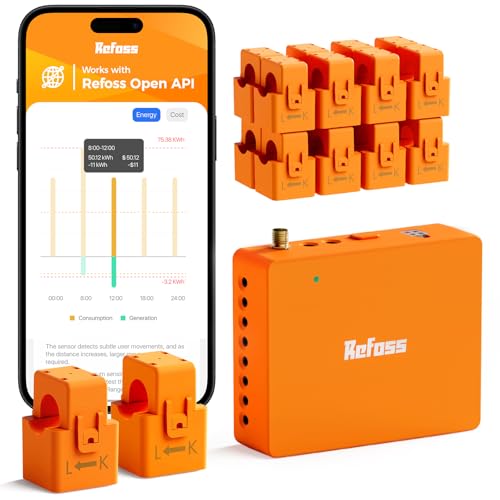
Refoss Smart Home Energy Monitor Review Summary
The Refoss Smart Home Energy Monitor makes sense for homeowners who want to understand where electricity goes, reduce waste, and automate around solar or peak-demand patterns.
It is especially strong if you value local privacy, want Home Assistant compatibility, and need a system that can track many circuits with professional-grade precision.
The main appeal is not flashy hardware.
It is the combination of broad measurement coverage, local web access, open API support, MQTT, and long-term data retention.
That makes this a better fit for serious home energy management than for casual “see my bill on a phone” use.
If you want to audit HVAC, appliances, and other branch loads in detail, this product is built for that job.
Review Scorecard
| Category | Score | Buyer assessment |
|---|---|---|
| Circuit coverage | 9/10 | Tracks 18 individual circuits, which is a strong fit for whole-home visibility. |
| Privacy and control | 10/10 | Local web UI, open API, MQTT, and no cloud requirement are major advantages. |
| Solar and automation | 9/10 | Useful for directing surplus solar and managing peak-demand usage. |
| Data history | 9/10 | Five years of secure daily data storage is unusually practical for trend analysis. |
| Setup flexibility | 8/10 | Supports single-phase, split-phase, and 3-phase 4-wire Wye systems. |
| Reliability features | 8/10 | External antenna, ETL certification, and sensor flip correction improve real-world usability. |
| Value for serious users | 9/10 | Strong fit for people who will actually use the data to change behavior or automate loads. |
Key Features and Specifications of Refoss Smart Home Energy Monitor
The Refoss Smart Home Energy Monitor is designed for whole-home electrical insight with a strong bias toward local ownership of data.
The listing emphasizes 18 monitored circuits, professional ±1% precision, and support for both main and branch sensing in a single system.
It supports single-phase, split-phase, and 3-phase 4-wire Wye systems, which broadens its compatibility beyond a simple residential panel monitor.
The hardware setup includes 2 main sensors up to 200A and 16 branch sensors up to 60A, so it can cover a substantial panel layout when installed correctly.
The software side is the bigger differentiator.
Refoss lists a built-in Local Web UI, Open API, MQTT, and WebSocket support, plus Home Assistant integration through Refoss_RPC.
That matters if you want the monitor to feed dashboards, automations, or energy-control routines instead of just showing charts in a closed app.
Other notable facts from the listing:
- Daily data storage for 5 years with minute, hourly, daily, weekly, monthly, and yearly views
- CSV export without a subscription
- Smart alerts for unusual energy use patterns
- Solar metering and surplus energy management
- External high-gain antenna for better Wi-Fi stability
- ETL certification
- 2-year warranty
- Sensor direction correction in the app if a clamp is installed backward
Taken together, those features point to a monitoring system aimed at energy optimization, not just passive reporting.
Pros and Cons of Refoss Smart Home Energy Monitor
Pros
- Local-first data control with a built-in web UI and no cloud dependency
- Strong integration options for Home Assistant, MQTT, and open API workflows
- Wide circuit coverage with 18 monitored circuits
- Useful for solar households that want to optimize self-consumption
- Long retention window with five years of daily history
- Practical installation aids like sensor flip correction and an external antenna
Cons
- Best for technically engaged buyers rather than plug-and-forget users
- Installation complexity is inherent to panel-based energy monitors
- Feature depth may be overkill if you only want simple whole-home usage totals
- Branch sensor limits mean you still need to plan which circuits matter most
The strongest pro is that this is built like a tool for energy management, not a cloud dashboard with hardware attached.
The biggest drawback is also the same thing: the product assumes the buyer actually wants to act on the data.
Who Should Buy Refoss Smart Home Energy Monitor?
This is a good fit for homeowners who want to break down electricity use by circuit, especially if they already use Home Assistant or another automation platform.
It also makes sense for people with solar panels who want to route surplus generation toward meaningful loads instead of feeding everything back with little control.
It is a strong choice if you care about privacy, want local access, or prefer a monitor that can keep working even when internet service is unreliable.
The five-year history and CSV export are also valuable for anyone doing seasonal comparisons or long-term efficiency projects.
You should probably skip it if you only want a basic monthly usage summary.
It is also not the best match for buyers who do not want to open a panel, think through circuit mapping, or deal with the installation side of a serious monitor.
If simplicity is the top priority, a lighter-weight whole-home solution may be a better fit.
Local Control and Energy Management Fit of Refoss Smart Home Energy Monitor
Local Web UI and Open API
The local web interface and open API are the biggest reasons this product stands out.
They let advanced users monitor energy without depending on a cloud account, which is useful for privacy, reliability, and custom integrations.
Home Assistant and MQTT Integration
For smart-home buyers, the support for Home Assistant, MQTT, and WebSocket is a real advantage.
It means the monitor can participate in automations rather than just reporting numbers after the fact.
Solar Self-Consumption Planning
The solar-oriented features are practical for households with panels or net metering.
The listing suggests using surplus energy for medium-power appliances and managing load timing around peak demand, which can improve how much generated power you actually use.
Long-Term Usage Analytics
Five years of stored daily data gives this monitor a real edge for trend analysis.
That makes it more useful for spotting changes in appliance behavior, comparing seasons, or checking whether efficiency projects are actually working.
Alternatives to Refoss Smart Home Energy Monitor
If you want similar Amazon options, start with Emporia Vue energy monitor, Sense energy monitor, and Schneider Electric Wiser Energy Monitor.
Each is worth comparing if you want panel-level insight, app-based monitoring, or a different smart-home ecosystem fit.
Emporia is often the closest comparison for buyers who want detailed circuit visibility and app-based energy tracking.
Sense is a more mainstream whole-home option for people who care about broad appliance insight.
Schneider Electric Wiser is worth a look if you prefer a more established electrical brand in the energy-monitoring space.
Is Refoss Smart Home Energy Monitor Worth It?
Yes, if your goal is real energy management instead of casual usage tracking.
The Refoss Smart Home Energy Monitor is worth considering when you want circuit-level visibility, local control, strong smart-home integration, and solar-aware optimization in one package.
It is less compelling for buyers who want the easiest possible install or only need a quick estimate of household consumption.
For homeowners ready to use the data, though, this is a serious, privacy-conscious monitoring system with the right feature set to justify its complexity.