
If you are searching for an OBD2 scanner review that goes beyond basic code reading, the OBD2 V321 scanner is worth a close look.
It aims at DIY owners who want clear diagnostics, battery checks, and simple reporting in one handheld tool.
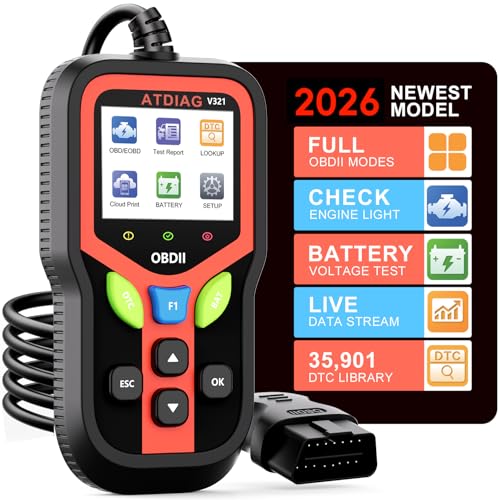
V321 Scanner Review Summary
The OBD2 V321 scanner makes the most sense for drivers who want a straightforward diagnostic tool instead of a phone-dependent app setup.
It is positioned as a plug-and-play reader for check engine light troubleshooting, live data, battery testing, and freeze-frame review, so it suits home mechanics, fleet-minded owners, and beginners who want more than a bare code reader.
Verdict: this is a practical, feature-dense scanner for everyday vehicle checks, not a specialty tool for advanced ECU work.
The listing suggests a strong fit if you want fast fault-code access, battery health checks, and a screen you can use without extra devices.
Review Scorecard
| Category | Score | Buyer assessment |
|---|---|---|
| Code Reading | 9/10 | Reads and clears trouble codes, with access to a large built-in fault-code library. |
| Live Diagnostics | 8/10 | Supports real-time sensor data such as RPM, coolant temperature, and fuel pressure. |
| Battery Testing | 8/10 | Includes a dedicated battery check mode, which adds value for routine maintenance. |
| Ease of Use | 9/10 | Plug-and-play design, shortcut keys, and a color display make it beginner-friendly. |
| Vehicle Compatibility | 8/10 | Covers most OBDII vehicles from 1996 onward in the US, with broader regional support listed. |
| Build and Portability | 8/10 | Rugged case, insulated cable, and broad temperature tolerance suggest practical durability. |
| Reporting and Sharing | 7/10 | Cloud printing and QR-based report sharing are useful, though not essential for every buyer. |
Key Features and Specifications of V321 Scanner
The key appeal of the OBD2 V321 scanner is that it combines several common diagnostic tasks into one handheld unit.
According to the listing, it can read and clear trouble codes, show I/M readiness status, display live sensor data, run EVAP tests, check battery health, and capture freeze-frame data.
It also includes a built-in library that decodes more than 35,901 fault codes.
That matters because it can help you interpret a code without jumping between a phone, a forum, and a separate reference tool.
Other notable listing details:
- Works with most cars manufactured after 1996 in the US, 2000 in the EU, and 2008 in Asia that use a standard 16-pin OBD2 port.
- Supports 10 languages, including English, Spanish, French, and Portuguese.
- Uses shortcut keys for faster access to reports, fault-code reading, and battery testing.
- Has tri-color indicator lights for quick status awareness.
- Includes cloud-based QR code printing for saving or sharing results.
- Uses a 2.4-inch color display.
- Comes with a 3.0-foot insulated cable and a rugged silicone case.
- Is listed as operating from -22°F to 158°F.
- Can support diagnostics across multiple vehicles for up to 24 hours.
- Is described as plug-and-play with no batteries required.
These are the kinds of details that make the V321 scanner more appealing than a minimal code reader.
It is designed to be used directly in the garage or driveway, with enough built-in guidance to reduce friction for less technical buyers.
Pros and Cons of V321 Scanner
Pros
- Broad diagnostic coverage. The ability to read and clear codes, view live data, check readiness, and run EVAP testing covers the most common at-home use cases.
- Battery check mode adds real utility. Battery testing is especially useful when a car is hard to start or electrical issues are suspected.
- Simple standalone hardware. The screen, shortcut keys, and no-battery design make it easier to use than app-centric tools.
- Useful for beginners. The listing emphasizes plug-and-play operation and a clear manual, which lowers the learning curve.
- Built for shop-like handling. The rugged case and insulated cable point to a tool intended for repeated use.
Cons
- Not aimed at advanced diagnostics. Nothing in the listing suggests bidirectional control, coding, or deep module access.
- Screen size is modest. A 2.4-inch display is functional, but not spacious compared with larger professional scanners.
- Report features may be situational. Cloud printing and QR sharing are helpful, but some buyers may never use them.
- Compatibility still needs checking. The listing itself recommends verifying vehicle fit before purchase.
Who Should Buy V321 Scanner?
The OBD2 V321 scanner is a good fit for drivers who want a dependable everyday diagnostic tool with more functionality than a bargain code reader.
It is especially sensible for people who want to understand a check engine light, review live sensor behavior, and test battery health without needing to connect a phone or learn a full professional scan workflow.
It also makes sense for DIY owners who maintain multiple vehicles, because the listing positions it as compatible with a wide range of OBDII cars and usable for extended diagnostic sessions.
The shortcut keys and on-device display are a genuine advantage for anyone who wants a quick answer in the garage.
You should probably skip it if you need advanced dealership-style functions, detailed coding support, or a larger professional interface.
If your main goal is deep module programming, this is not the category for that job.
Diagnostic Value and Everyday Use
Check Engine Light Workflow
The strongest use case here is simple fault-finding.
Read the code, view the freeze frame, check the readiness status, and decide whether the issue looks urgent or intermittent.
That is the kind of flow most owners want when the warning light appears unexpectedly.
Battery and Starting Problems
Battery testing is a meaningful addition because many “check engine” moments are actually power or charging concerns in disguise.
A scanner that can also evaluate battery health gives you a broader first pass before you replace parts.
Live Data for Smarter Decisions
Live sensor data is useful when the code alone does not tell the full story.
RPM, coolant temperature, and fuel pressure are especially relevant for deciding whether a problem is likely electrical, cooling-related, or fuel-system related.
Portability and On-Car Convenience
The small color display, physical keys, and plug-and-play design are all about convenience.
This is the sort of tool you can keep in the glove box, grab during a roadside check, or hand to a less experienced driver without a long setup process.
Alternatives to V321 Scanner
If you want a comparable Amazon buy, the most obvious alternatives are established OBD2 scanner lines such as BlueDriver OBD2 Scanner, Ancel OBD2 Scanner, Foxwell OBD2 Scanner, and Autel OBD2 Scanner.
Those brands are worth comparing if you want different tradeoffs in screen size, app integration, menu depth, or overall reputation.
The right choice depends on whether you want the simplest handheld reader, a richer app-connected experience, or a more advanced scanner for occasional heavier use.
Is V321 Scanner Worth It?
For buyers who want a practical, self-contained OBD2 tool, the OBD2 V321 scanner looks worth considering.
It combines the basics most people actually use with extras like battery testing, live data, freeze-frame access, and report sharing, which gives it a broader role than a cheap code reader.
If your priorities are ease of use, routine diagnostics, and a tool that can help you decide what to do next, this is a sensible pick.
If you need deeper service functions or advanced programming features, look at a higher-end scanner instead.