
Jackery Explorer 240D Power Bank review 2026: this compact power station is built for people who want small-package backup power without carrying a bulky AC unit.
It makes the most sense if you care about DC output, portability, and long battery life.
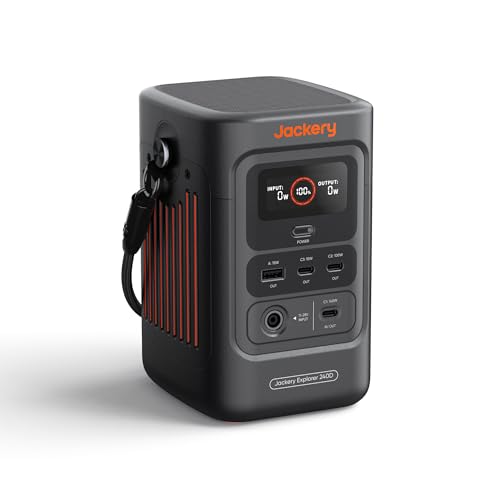
Jackery Explorer 240D Review Summary
The Jackery Explorer 240D is an easy product to understand: it trades broad household-style AC flexibility for a lighter, more travel-friendly DC power setup.
That makes it a strong fit for campers, road-trippers, emergency kits, and anyone who wants to keep phones, tablets, cameras, and other USB-powered gear alive without hauling a larger station.
The listing focuses on portability, fast charging, and battery longevity, and those are exactly the features that define its value.
Verdict: buy it if you want compact, durable portable power and do not need an AC inverter. The 240D is better judged as a specialized travel power bank than a full do-everything backup station.
Review Scorecard
| Category | Score | Why it scores this way |
|---|---|---|
| Portability | 9/10 | The listing emphasizes a 4.85 lb body and compact dimensions, which is unusually easy to carry for this class. |
| Charging flexibility | 8/10 | It supports AC-DC dual input, solar, car charging, and USB-C, so it covers most real-world recharge scenarios. |
| Device compatibility | 7/10 | Four outputs and up to 200W DC output work well for modern personal electronics, but this is not an AC-first solution. |
| Battery longevity | 9/10 | LiFePO4 chemistry and a 10-year lifespan claim make it attractive for long-term ownership. |
| Emergency usefulness | 8/10 | Strong for outages, road trips, and field use when your devices run on DC or USB power. |
| Everyday convenience | 8/10 | The included strap cable and fast-charge story improve usability, especially for grab-and-go carry. |
| Overall value fit | 8/10 | The appeal is clear if you want a compact, durable, purpose-built power bank; less so if you need broader AC support. |
Key Features and Specifications of Jackery Explorer 240D
The core spec set points to a compact battery pack rather than a heavy power station.
The listing says the Explorer 240D carries 256Wh of energy and provides 200W of pure DC output, with up to 140W per port across three USB-C ports and one USB-A port.
That mix makes it a practical hub for smaller electronics instead of kitchen appliances or other AC-heavy loads.
The product is also built around mobility.
Jackery lists a weight of 4.85 pounds and dimensions of 4.73 x 4.19 x 6.69 inches.
That is a meaningful advantage if you want something you can actually toss into a pack, car organizer, or emergency shelf without rearranging your whole setup.
Battery chemistry is one of the most important selling points here.
The Explorer 240D uses an upgraded LiFePO4 lithium battery, with a claimed 10-year lifespan and performance retention of at least 70% after 6,000 charge cycles.
That is the kind of spec that matters for buyers who plan to keep a unit in service for years, not months.
Charging options are broad for a product this small.
The listing includes USB-C, solar, car charging, and AC-DC dual input.
With the 100W charger, Jackery says the dual-input path can take the unit from 0% to 80% in about one hour.
It also supports up to 100W solar charging, which adds flexibility for campsite or off-grid use.
Other notable details:
- Included cable/strap: a 2-in-1 USB-C strap cable that acts as both a carry strap and a fast-charging cable.
- Temperature range claim: designed to operate from -4°F to 113°F.
- Intended use cases: camping, hiking, travel, road trips, and backup power for outages or emergencies.
- Color: black.
Taken together, those specs tell you what this product is and what it is not.
It is optimized for compact DC power and long service life, not for running full-size appliances.
Pros and Cons of Jackery Explorer 240D
Pros
- Very portable for its class. The weight and size are the biggest immediate advantages.
- Long-life battery chemistry. LiFePO4 is a sensible choice if you want durability and lower ownership anxiety.
- Fast, flexible recharging. Solar, car, AC-DC dual input, and USB-C give you options.
- Useful output spread. Four ports and up to 140W per port are practical for modern mobile devices.
- Good travel fit. The strap cable is a smart touch for grab-and-go use.
Cons
- No AC-first positioning. Buyers looking to run wall-plug appliances should look elsewhere.
- Capacity is modest. 256Wh is enough for portable electronics, but it is not meant to be a whole-home backup solution.
- Best value depends on your device mix. If your gear needs AC outlets more than USB-C and DC, the design is less compelling.
- Specialized rather than universal. The 240D solves a specific portability problem, which limits its audience.
Who Should Buy Jackery Explorer 240D?
This is a good purchase for people who know they want a small, long-life portable power source for phones, tablets, cameras, handheld electronics, and other USB-C-centered gear.
It also fits outdoor users who value weight savings, since the listing repeatedly pushes the compact and lightweight angle.
It should also appeal to anyone building a car kit or emergency kit and wanting a power source that is easier to store than a full station.
The broad charging options are useful here, especially solar and car charging.
You should probably skip it if your main need is AC outlet power, high-capacity household backup, or a station that can replace a larger inverter-based unit.
The 240D is more about clean, portable DC utility than all-purpose backup.
Portable Power Fit for Jackery Explorer 240D
Why the size matters
At this capacity, portability is the real differentiator.
The listing’s sub-5-pound weight and compact footprint are not just nice-to-haves; they are what make the 240D practical for camping, travel, and everyday storage.
Why the output profile matters
The four-port layout and 200W DC output are well matched to modern personal devices.
That means fewer compromises when you are charging several small gadgets at once, but it also reminds you that this is not a plug-everything-in station.
Why the battery chemistry matters
LiFePO4 is the right story for a product people may keep for years.
The long-cycle claim and 10-year lifespan positioning reduce the feeling that this is a short-term accessory.
Why the recharge options matter
Solar, car, USB-C, and AC-DC dual input make the 240D adaptable in the field and at home.
That flexibility is especially valuable if you rotate between travel, outages, and outdoor use.
Alternatives to Jackery Explorer 240D
If you want a similar portable-power idea but need a different balance of features, these are credible Amazon search alternatives:
- Anker portable power stations
- EcoFlow River series
- BLUETTI portable power stations
- Jackery Explorer series
Anker and EcoFlow are worth checking if you want a broader ecosystem or a different mix of portability and output.
BLUETTI is another reasonable comparison if you are shopping by battery technology and station style.
Staying inside Jackery’s own Explorer line also makes sense if you like the brand but want a different capacity or port layout.
Is Jackery Explorer 240D Worth It?
Yes, if your priority is compact, durable DC power for travel, outdoor use, and emergency carry. The Explorer 240D looks well thought out for buyers who care about portability, long battery life, and flexible recharging more than AC outlet versatility.
No, if you want a general-purpose power station for larger appliances or household-style backup. In that case, the 240D is too specialized.
For the right buyer, though, it is a sensible and focused buy.