
A reliable battery tester with a built-in printer can turn a quick vehicle check into a clear, professional report. These tools evaluate battery condition, starting performance, and charging-system behavior without relying on guesswork.
We’ve gathered 10 options covering 6V, 12V, and 24V systems, common battery types, broad CCA ranges, and different shop or roadside needs. Use the guide below to narrow the list by compatibility, reporting features, ease of use, and budget.
Best 10 Car Battery Testers with Printer Picks for 2026
Professional Shop Pick

- Tests 12V and 24V batteries from 100–2,000 CCA
- Built-in printer and 3.5-inch color screen
- Checks battery, cranking, and charging systems
Best For: Auto shops, battery dealers, and used-car inspections
Versatile Value Option
OBDResource BM550 Ultra Battery Tester

- Supports 6V, 12V, and 24V systems
- Prints reports with SOH, SOC, resistance, and CCA data
- Includes AH-to-CCA conversion and waveform monitoring
Best For: Mixed-vehicle testing and detailed battery diagnostics
Advanced Diagnostic Pick

- Adds resistance and sequence testing to battery diagnostics
- Built-in printer with up to 14 hours of standalone use
- Sequence testing supports batches of up to 5,000 batteries
Best For: Professional shops handling varied or high-volume testing
Portable Roadside Choice
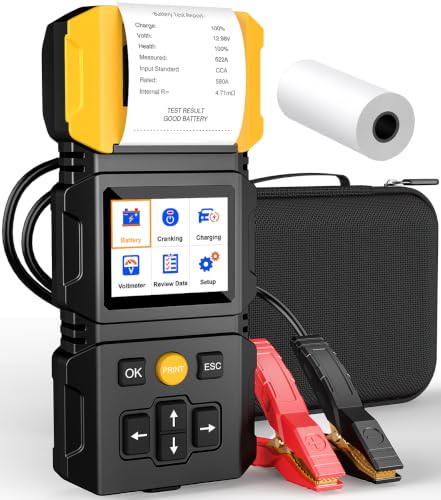
- Tests 12V/24V batteries, cranking, and charging systems
- One-click thermal report printing
- Includes hard case, spare paper, and safety protections
Best For: DIYers, mobile technicians, and roadside testing
Best All-Around 12V Pick

- Tests 12V/24V batteries from 100–2,000 CCA
- Prints results without ink or ribbons
- Checks battery, cranking, and charging systems
Best For: Multi-vehicle owners wanting fast printed diagnostics
Best for Shop-Style Testing

- Offers six battery and electrical test functions
- Supports numerous international battery-rating standards
- Prints reports and handles 12V/24V vehicle systems
Best For: Workshops and repeated multi-vehicle inspections
Most Versatile Diagnostic Tool
6V/12V/24V Printer Battery Tester

- Tests flooded, AGM, GEL, and EFB batteries
- Prints detailed health and performance reports
- Adds waveform monitoring and 800-record storage
Best For: Multi-vehicle testing, fleet checks, and battery disputes
Best Workshop Package
AUTOOL BT760 Printer Battery Tester

- Tests 12V and 24V systems up to 2000 CCA
- Prints and stores diagnostic records
- Includes case, paper rolls, and three-year warranty
Best For: Repair shops and technicians needing documented results
Best for High-Volume Use
Industrial 6V/12V/24V Battery Analyzer

- Tests major battery health and performance metrics
- Prints standardized reports for archiving
- Built for workshops, fleets, and industrial use
Best For: Frequent professional inspections and record keeping
Professional Shop Pick – TOPDON BT600 12V/24V Tester
The TOPDON BT600 is a practical choice among car battery testers with printer for shops and technicians who need broad 12V and 24V coverage. It tests battery health, cranking, and charging systems, then prints a thermal report for records or customer handoffs.
Best For: Auto shops, battery dealers, and used-car inspections involving cars, trucks, motorcycles, and boats.
Pros:
- Supports 12V and 24V lead-acid batteries from 100 to 2,000 CCA.
- Works with flooded, AGM, GEL, and EFB battery types.
- Large 3.5-inch color display and built-in thermal printer.
- Includes data playback and lifetime software optimization through Windows.
Cons:
- Software updates are compatible with Windows systems only.
- Its 1.29 kg weight may be more than needed for occasional DIY use.
With its larger screen, wide battery coverage, and report-printing capability, the BT600 is well suited to repeat diagnostic work. It offers a useful balance of professional functions and price-conscious value.
Versatile Value Option – OBDResource BM550 Ultra Battery Tester
The OBDResource BM550 Ultra is one of the more versatile car battery testers with printer, supporting 6V, 12V, and 24V automotive systems. It combines printed reports with detailed readings such as state of health, state of charge, internal resistance, and CCA.
Best For: Car owners, mechanics, and users testing vehicles, RVs, boats, trucks, or other 6V/12V/24V applications.
Pros:
- Supports 6V, 12V, and 24V systems with a 100–2,000 CCA range.
- Built-in thermal printer provides instant test reports.
- Displays SOH, SOC, internal resistance, voltage, and CCA results.
- AH-to-CCA conversion supports entered values from 2Ah to 220Ah.
Cons:
- The 1.8-inch color screen is smaller than the displays on some competing models.
- The supplied notes do not specify a carrying case or warranty.
The BM550 Ultra stands out when one tester needs to cover multiple system voltages and provide more than a basic pass-or-fail result. Its voltage waveform display and AH-to-CCA conversion add useful flexibility for varied testing jobs.
Advanced Diagnostic Pick – TOPDON BT600 Plus Tester
The TOPDON BT600 Plus is an advanced option among car battery testers with printer, adding resistance and sequence testing to standard battery, cranking, and charging checks. Its built-in printer, long-lasting internal battery, and high-volume sequence mode make it especially suited to professional workflows.
Best For: Technicians and shops that need expanded testing, stored results, and sequence testing for larger battery volumes.
Pros:
- Tests 6V batteries and 12V/24V systems, with operation down to 2V.
- Supports battery, resistance, sequence, cranking, charging, and system tests.
- Built-in printer and 5,200mAh battery provide up to 14 hours of standalone operation.
- Sequence testing can handle up to 5,000 batteries in one run.
Cons:
- Its expanded feature set may be unnecessary for basic home battery checks.
- Only 10 records per test type are saved, excluding sequence tests.
The BT600 Plus is the most feature-heavy choice in this group. Its sequence mode and resistance testing can improve shop efficiency, while the large display and customizable settings keep daily operation approachable.
Portable Roadside Choice – OBDMATE BT770 Battery Tester
The OBDMATE BT770 is a portable pick among car battery testers with printer, offering 12V and 24V battery, cranking, and charging tests in a rugged kit. Its thermal printer produces one-click reports, while the included case and spare paper make it convenient for garages, home mechanics, and roadside use.
Best For: DIYers, mobile technicians, and vehicle owners testing cars, trucks, motorcycles, RVs, boats, and powersports equipment.
Pros:
- Supports 12V/24V vehicles and 100–2,000 CCA lead-acid batteries.
- Prints battery, cranking, and charging reports with one click.
- Includes a hard carrying case, USB-C cable, and two paper rolls.
- Offers reverse-polarity, leakage, and overload protection.
Cons:
- It does not list 6V testing support.
- The display is 2.8 inches, smaller than the 3.5-inch screens on some alternatives.
The BT770 makes a strong case for users who value portability and straightforward operation. Its durable construction, long test leads, included accessories, and printed reports make it particularly practical outside a fixed workshop.
Best All-Around 12V Pick – Lancol LC310 with Printer
If you want a practical choice among car battery testers with printer, the Lancol LC310 combines quick battery, cranking, and charging-system checks with printed diagnostic receipts. It supports 12V and 24V lead-acid batteries rated from 100 to 2,000 CCA, including flooded, AGM, GEL, EFB, and maintenance-free types, plus lithium batteries.
Best For: Drivers, technicians, and powersports owners who want broad battery compatibility and quick printed results.
Pros:
- Tests battery health, cranking, and charging systems in about three seconds.
- Built-in thermal printer requires only standard thermal paper—no ink or ribbons.
- 2.4-inch LCD, long cable, Kelvin clamps, and reverse-polarity protection support convenient operation.
- Works with cars, trucks, motorcycles, RVs, ATVs, boats, lawnmowers, and golf carts.
Cons:
- Designed around 12V and 24V systems rather than 6V batteries.
- Printed reports require replacement thermal paper.
The LC310 is a versatile pick when you need one tester for several vehicle types. Its broad compatibility and fast thermal printing make it especially useful for routine diagnostics and documenting battery results.
Best 6V/12V/24V Coverage – OBDMONSTER BM550U
The OBDMONSTER BM550U is one of the more flexible car battery testers with printer for shops and home garages because it supports 6V, 12V, and 24V automotive batteries from 100 to 2,000 CCA. It reports voltage, internal resistance, state of health, state of charge, and CCA, then can print the results immediately.
Best For: Users who need 6V compatibility, detailed battery readings, and included thermal-paper rolls.
Pros:
- Supports 6V, 12V, and 24V lead-acid, AGM, and gel batteries.
- Measures internal resistance, voltage, SOH, SOC, and CCA using a detailed diagnostic approach.
- Includes a built-in thermal printer and two standard rolls of paper.
- Offers waveform monitoring plus reverse-polarity, anti-spark, overvoltage, and over-temperature protection.
Cons:
- Not compatible with lithium batteries.
- Its 1.8-inch display is smaller than some competing models.
Choose the BM550U if voltage-range flexibility and more detailed reporting matter more than lithium support. The waveform view and included paper add practical value for repeated testing.
Best for Shop-Style Testing – Launch BST-860S
The Launch BST-860S is a strong option among car battery testers with printer when you want more than a basic battery check. It provides six test functions, supports multiple international rating standards, and prints health reports from its built-in thermal printer in about three seconds.
Best For: Workshops and users who regularly test automotive, powersports, commercial, and Group 31 batteries.
Pros:
- Provides battery, ripple, electric-current, starter, charging-system, and voltage tests.
- Supports CCA, BCI, CA, MCA, JIS, DIN, IEC, EN, SAE, and GB measurement standards.
- Tests 12V batteries and 12V/24V vehicle starter and charging systems.
- Supports flooded, gel, AGM, EFB, and lithium batteries, including Group 31 and 4D/8D applications.
Cons:
- Its minimum operating voltage is 12V, so it is not intended for 6V systems.
- Thermal paper is needed for continued report printing.
The BST-860S stands out for repeated or batch inspections, with a broad set of electrical tests and support for varied battery-rating standards. It is a sensible fit for users who want a more comprehensive analyzer than a simple voltage tester.
Most Versatile Diagnostic Tool – 6V/12V/24V Printer Battery Tester
If you need car battery testers with printer functionality across multiple vehicle types, this handheld model covers 6V, 12V, and 24V lead-acid batteries. It combines battery, cranking, charging, load, and waveform modes with on-the-spot thermal reports.
Best For: DIY users, fleets, repair shops, and anyone who needs printed battery health reports for cars, trucks, motorcycles, boats, or golf carts.
Pros:
- Supports flooded, AGM flat plate, AGM spiral, GEL, and EFB batteries across 10 testing standards.
- Prints CCA, voltage, internal resistance, SOC, SOH, and the test verdict without ink or ribbons.
- Includes waveform monitoring, 800-record storage, reverse-polarity protection, and copper clamps.
- Works with standard 57x30mm thermal paper and includes a roll in the box.
Cons:
- The supplied details do not specify a rechargeable internal battery, so power requirements may need checking before purchase.
- Its broad feature set may be more than occasional users need.
This is the strongest all-around choice when compatibility and detailed documentation matter. The waveform mode and printed results add useful evidence beyond a basic voltage check, while the compact design keeps it practical for mobile testing.
Best Workshop Package – AUTOOL BT760 Printer Battery Tester
The AUTOOL BT760 is a practical option among car battery testers with printer capability, offering 12V and 24V testing, a bright 3.2-inch color screen, and one-click report printing. Its four diagnostic modes cover common workshop checks.
Best For: Automotive technicians, service writers, and DIY users who want stored test records, printed reports, and support for cars, trucks, motorcycles, ATVs, RVs, and boats.
Pros:
- Performs battery health, cranking, charging, and load tests across a 30–2000 CCA range.
- Supports flooded, AGM, EFB, and gel lead-acid batteries.
- Offers one-click printing, internal data storage, reverse-polarity protection, and a bright color display.
- Includes a protective case, two print-paper rolls, and a stated three-year limited warranty.
Cons:
- Its stated minimum operating voltage is 8V, so it may not suit every deeply discharged battery.
- The supplied details do not list 6V battery support.
The BT760 stands out for organized shop use: its saved records and printed reports can simplify customer communication and trend tracking. It is a focused 12V/24V tester rather than the broadest-voltage option in this roundup.
Best for High-Volume Use – Industrial 6V/12V/24V Battery Analyzer
This model is designed for buyers who need car battery testers with printer output for repeated professional testing. It supports 6V, 12V, and 24V lead-acid batteries and prints standardized reports covering the main battery-health measurements.
Best For: Workshops, fleets, marine operations, and industrial users handling frequent battery inspections and needing paper records for archiving or comparison.
Pros:
- Uses impedance testing and proprietary algorithms to assess battery condition.
- Measures internal resistance, voltage, SOH, SOC, and CCA for a broad performance overview.
- Supports standard lead-acid, AGM flat-plate, AGM, and gel batteries from 100–2000 CCA.
- Rugged construction, rapid setup, printer output, and safety protections suit demanding work environments.
Cons:
- The stated CCA range starts at 100, limiting compatibility with lower-rated batteries.
- The supplied notes do not specify included paper, warranty length, display size, or supported testing standards.
Choose this analyzer when throughput and repeatable documentation are priorities. Its industrial positioning and built-in safeguards are appealing for regular professional use, although buyers should verify the missing package and warranty details before ordering.
How We Picked the Best Car Battery Testers with Printer
We focused on testers that combine battery diagnostics with an integrated thermal printer, so results can be recorded or handed to a customer immediately. The selection includes models for standard 12V vehicles as well as equipment using 6V or 24V systems. We also considered support for common battery constructions, including conventional lead-acid, AGM, gel, and EFB batteries where specified.
Other priorities included displayed test information, claimed CCA coverage, cranking and charging-system checks, screen usability, portability, and practical value. Because specifications can vary by seller or revision, verify the exact included accessories, supported standards, and printer-paper format before ordering.
Quick Comparison
| Best For | What to Prioritize | Typical Fit |
|---|---|---|
| Home and DIY maintenance | Simple controls, clear results, low cost | 12V vehicles |
| Repair shops | Fast testing, readable reports, durable construction | 12V and 24V systems |
| Mixed vehicle fleets | Wide voltage and battery-type support | 6V, 12V, and 24V |
| Customer documentation | Reliable built-in printer and easy report handling | Routine service diagnostics |
Key Buying Factors for Car Battery Testers with Printer
Voltage and Battery Compatibility
Choose a tester that matches the vehicles you service. A 12V-only model may be sufficient for most cars, while 6V/12V/24V coverage is more useful for motorcycles, commercial vehicles, trucks, or fleet equipment. Confirm the supported battery chemistries and testing standards as well as the voltage range.
CCA Range and Test Functions
Check whether the tester covers the battery’s rated cold-cranking amps. A broad range, such as 30–2,000 CCA, offers more flexibility, but range alone does not guarantee accuracy. Look for separate tests for battery health, cranking performance, alternator output, and charging-system behavior.
Printer and Report Usability
A built-in printer is most useful when paper is easy to replace and results are legible. Consider print speed, report detail, paper availability, and whether the device stores or displays previous readings. A clear screen and straightforward menus also reduce testing errors in busy service environments.
Construction and Everyday Operation
For frequent shop use, prioritize sturdy leads, protected controls, a readable color display, and a compact design that is easy to carry between vehicles. If you work outdoors, check whether the operating temperature range and screen visibility suit the environment.
Who Should Buy Which Car Battery Testers with Printer?
DIY owners who mainly service modern cars can choose a straightforward 12V tester with clear results and affordable replacement paper. Independent garages should look for a faster unit with alternator and cranking tests, a broad CCA range, and a printer designed for repeated use. Fleet operators and technicians working on mixed equipment will benefit most from 6V/12V/24V support and compatibility with several battery types.
If customer-facing documentation matters, prioritize print quality and report clarity over the lowest price. Whichever model you choose, compare its specifications with the battery label and vehicle requirements before testing, and follow the manufacturer’s connection and safety instructions.