
A dependable battery tester can help you check starting power, charging performance, and possible electrical problems before a no-start becomes an emergency. The right tool can also make routine maintenance easier without requiring a trip to a repair shop.
We compare 10 car battery testers for home use, from straightforward voltage meters to load testers with CCA readings and alternator checks. Use the guide below to match the tester’s capabilities with your vehicle, battery type, and comfort level.
Best 10 Car Battery Testers for Home Use Picks for 2026
Best Overall
ANCEL BA101 Digital Battery Tester

- Reports SOH, SOC, voltage, CCA, and charging results
- Tests compatible 12V batteries over 30Ah
- Built-in protection and readable backlit display
Best For: Detailed 12V diagnostics at home
Best Load Tester
Yaegoo 6V/12V Battery Load Tester

- Supports both 6V and 12V batteries
- Provides 50A or 100A load testing
- Tests batteries up to 1,000 CCA
Best For: Traditional load testing in a home garage
Best Compact Option
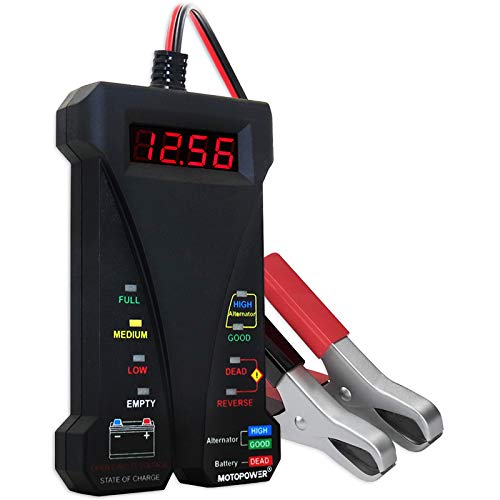
- Plug-and-test design for quick checks
- Displays voltage to 0.01V with a four-digit LCD
- Includes LED battery and alternator indicators
Best For: Portable 12V voltage and charging checks
Best Heavy-Duty Design

- Works with 6V and 12V batteries
- Tests up to 1,000 CCA with alternator testing
- Uses a shock-resistant steel case and heavy-duty clamps
Best For: Durable multi-vehicle garage testing
Best Professional-Style Pick

- Tests 12V battery, cranking, and charging systems
- Conductivity testing with historical result review
- Spark-free and reverse-polarity protection
Best For: DIY owners wanting detailed 12V diagnostics
Best Simple Voltage Monitor

- Tests 12V batteries and alternator output
- Approximate 0.01V accuracy with LCD display
- Reverse-connection and voltage-range protection
Best For: Basic voltage checks across many vehicle types
Best Load-Test Option

- 12V load tester for 100–2000 CCA batteries
- Checks cranking and charging systems
- Includes storage bag and two-year warranty
Best For: Home garages wanting conventional 12V load testing
Best Guided Tester

- Battery, cranking, and charging-system checks
- Color results with next-step guidance
- Long 8.2-foot cable for one-person testing
Best For: DIY users testing 6V and 12V lead-acid batteries
Best Multi-Voltage Option

- Tests 12V and 24V batteries from 50–2,000 CCA
- Color display for direct-sunlight readability
- Includes four-wire clamps and safety protections
Best For: Households maintaining cars, trucks, boats, and other vehicles
Best Simple Plug-and-Play Tester

- Tests 6V, 12V, and 24V batteries
- Reports CCA, voltage, resistance, SOH, and SOC
- Quick results with reverse-polarity protection
Best For: Beginners seeking fast battery-only diagnostics
Best Overall – ANCEL BA101 Digital Battery Tester
For drivers comparing car battery testers for home use, the ANCEL BA101 is a versatile digital option for checking 12V batteries and charging systems. It reports voltage, CCA, State of Health, State of Charge, cranking, and charging results in a compact, easy-to-read format.
Best For: Home users who want detailed 12V battery, cranking, and alternator diagnostics.
Pros:
- Measures SOH, SOC, voltage, current, and CCA.
- Tests cranking and charging systems without internal batteries.
- Supports flooded, AGM, GEL, and EFB 12V batteries over 30Ah.
- Includes reverse-polarity, short-circuit, overcurrent, and overvoltage protection.
Cons:
- Does not support lithium, 6V, 8V, or 24V batteries.
- Not intended for motorcycles below 30Ah.
The BA101 is a strong all-around pick when you want more than a simple voltage reading. Entering the battery’s correct type and rating is important for the most dependable results.
Best Load Tester – Yaegoo 6V/12V Battery Load Tester
The Yaegoo is a straightforward choice among car battery testers for home use, especially if you need a traditional load test. It works with both 6V and 12V batteries and provides a high-current test for vehicles including cars, trucks, RVs, motorcycles, and boats.
Best For: Home garages needing a simple 6V/12V load tester for varied vehicles.
Pros:
- Tests 6V batteries with a 50A load and 12V batteries with a 100A load.
- Supports batteries up to 1,000 CCA.
- Can check battery condition, starter draw, and charging systems.
- Ventilated case, insulated handle, and color-coded clip grips support practical use.
Cons:
- Provides a traditional load-test approach rather than the broader digital readings of advanced analyzers.
- Load testing can produce heat, so the ventilated design still requires sensible handling.
Choose this model if you prefer a direct load test and need compatibility with both 6V and 12V systems. Its compact handled design also suits occasional garage or home use.
Best Compact Option – MOTOPOWER MP0514A 12V Tester
If you want car battery testers for home use that are quick to connect and easy to read, the MOTOPOWER MP0514A keeps the process simple. Its plug-and-test design measures 12V battery voltage and provides a separate indication of alternator status after the vehicle starts.
Best For: Drivers who want a compact 12V voltage and charging-system checker.
Pros:
- Uses a simple plug-and-test setup.
- Four-digit LCD displays readings with accuracy up to 0.01V.
- Eight colored LED indicators help interpret battery and alternator status.
- Includes reverse-connection and over-voltage protection.
Cons:
- Designed for 12V vehicles rather than 6V or 24V systems.
- Focuses on voltage and charging checks instead of CCA or battery-capacity testing.
The MP0514A is a practical pick for routine checks and emergency glove-box storage. Its compact 150-gram design and 50cm cable make it convenient when you mainly need fast voltage and alternator information.
Best Heavy-Duty Design – QWORK 12V 100A Load Tester
The QWORK 12V 100A is a sturdy option among car battery testers for home use, combining battery load testing, voltage checks, and alternator testing. It supports 6V and 12V batteries and is built around a shock-resistant steel case with heavy-duty copper-plated clamps.
Best For: Home mechanics and vehicle owners who value a durable tester for cars, trucks, RVs, golf carts, and similar equipment.
Pros:
- Tests both 6V and 12V batteries.
- Supports batteries up to 1,000 CCA.
- Includes alternator testing in addition to load and voltage checks.
- Steel case, copper-plated clamps, and carrying handle support regular handling.
Cons:
- The supplied information does not specify warranty details.
- Its load-tester design may be less convenient than a compact digital analyzer for quick readings.
Consider the QWORK when durability and broader 6V/12V compatibility matter more than a lightweight digital interface. The included handle and compact form make it manageable for home storage and vehicle maintenance.
Best Professional-Style Pick – TOPDON BT50
For shoppers comparing car battery testers for home use, the TOPDON BT50 offers a broader diagnostic approach than a basic voltage check. It tests 12V lead-acid batteries, cranking capability, and charging-system performance, while its compact design and one-button operation keep routine checks approachable.
Best For: DIY vehicle owners who want battery, starting, and alternator insights across cars, trucks, motorcycles, boats, and other compatible vehicles.
Pros:
- Analyzes 12V battery health, cranking ability, and charging-system efficiency.
- Uses conductivity testing for quick results and includes historical test-result review.
- Includes reverse-polarity, spark-free, and anti-overheating protections.
- Bright LCD, one-button operation, six-language interface, and 12-month warranty.
Cons:
- Designed for 12V lead-acid batteries rather than a wider range of battery voltages.
- Its more comprehensive diagnostic features may be more than needed for simple voltage checks.
The BT50 is a strong choice when you want a compact home tester that can help track battery decline and investigate charging or starting concerns, not just display voltage.
Best Simple Voltage Monitor – ANENG BT172
The ANENG BT172 is a straightforward option for people seeking car battery testers for home use. It checks 12V batteries and alternator output, displays live voltage on an LCD, and uses LED indicators to make battery and charging status easier to interpret.
Best For: Home users who want an easy voltage-based check for cars, motorcycles, trucks, RVs, ATVs, boats, mowers, and golf carts.
Pros:
- Tests 12V batteries and analyzes alternator charging performance.
- Offers approximately 0.01V accuracy with a 4–30V DC test range.
- LCD voltage readout and LED status indicators support simple operation.
- Reverse-connection protection and low/high voltage alerts help prevent misuse.
Cons:
- Provides voltage and charging analysis rather than the BT50’s broader battery-health and cranking assessment.
- Requires correct red-positive and black-negative clamp connections.
Choose the BT172 if your main goal is to monitor voltage and identify obvious alternator or battery issues without a more involved testing workflow.
Best Load-Test Option – MOTOPOWER MP0515A
For home garages looking for car battery testers for home use with a traditional load-testing focus, the MOTOPOWER MP0515A is built for 12V automotive batteries. Its stated functions cover battery load testing, cranking, and charging-system checks, and it includes a storage bag for keeping the tester organized.
Best For: Vehicle owners who prefer a conventional 12V load tester for car-battery and starting-system checks.
Pros:
- Tests 12V batteries across a 100–2000 CCA range.
- Designed for battery load, cranking, and charging-system testing.
- Includes a storage bag and instruction manual.
- Backed by a two-year manufacturer warranty.
Cons:
- Its listed compatibility is focused on car batteries and 12V systems.
- The supplied details do not specify advanced features such as multilingual operation or historical result storage.
The MP0515A makes sense for shoppers who want a dedicated, conventional load tester and value included storage plus a longer stated warranty.
Best Guided Tester – BT900 Battery Tester
If you want car battery testers for home use that explain more than just a voltage reading, the BT900 combines battery-health, cranking, and charging-system checks with guided on-screen recommendations. Its long cable also makes one-person charging tests easier from the driver’s seat.
Best For: Home users who want step-by-step guidance for testing 6V and 12V lead-acid batteries on cars, motorcycles, ATVs, RVs, trucks, and boats.
Pros:
- Tests battery health, cranking voltage, charging voltage, alternator output, and ripple.
- Color results and a second guidance screen suggest whether to recharge, retest, inspect the charging system, or replace the battery.
- Supports several lead-acid types and rating standards, including CCA, EN, SAE, DIN, JIS, IEC, CA, MCA, and BCI.
- The 8.2-foot cable supports one-person charging-system testing.
Cons:
- It is not designed for 24V systems or lithium batteries.
- Its maximum operating voltage is 16V, limiting it to 6V and 12V applications.
The BT900 stands out when you want practical next-step advice alongside measurements. It is a strong fit for DIY maintenance, provided your vehicles use compatible lead-acid batteries.
Best Multi-Voltage Option – KAIWEETS KVB02 Battery Tester
Among car battery testers for home use, the KAIWEETS KVB02 is a versatile choice for households with multiple vehicle types. It tests 12V and 24V batteries from 50 to 2,000 CCA and displays key battery-health and starting information on a sunlight-readable color screen.
Best For: Multi-vehicle households, winter drivers, and home mechanics working with 12V or 24V flooded, EFB, AGM, and GEL batteries.
Pros:
- Supports 12V and 24V batteries with CCA ratings from 50 to 2,000.
- Measures state of health, state of charge, voltage, resistance, and CCA.
- The 2.68-inch color display is designed for visibility in direct sunlight.
- Includes Kelvin 4-wire clamps and protection against reverse polarity, short circuits, overcurrent, and overvoltage.
Cons:
- It requires a vehicle battery for power rather than using separate batteries.
- It is not specified for lithium batteries.
With broad 12V/24V compatibility, a color display, and a three-year warranty, the KVB02 is a practical home-garage tester for users who maintain several kinds of vehicles.
Best Simple Plug-and-Play Tester – BR502 Battery Analyzer
For shoppers comparing car battery testers for home use, the BR502 offers a straightforward way to check battery condition before problems become inconvenient. Connect its clips to a compatible battery, and it reports voltage, state of health, state of charge, CCA, and internal resistance.
Best For: Beginners who want a compact tester for 6V, 12V, and 24V flooded, AGM, or GEL batteries.
Pros:
- Supports 6V, 12V, and 24V batteries rated from 100 to 2,000 CCA.
- Displays test results in about two seconds on a 1.8-inch HD screen.
- Can test batteries in or out of a vehicle, including a dead battery according to the supplied notes.
- Reverse-polarity protection helps prevent damage from incorrectly connected clips.
Cons:
- The display is smaller than the color screen on some competing testers.
- Its supplied specifications focus on battery measurements rather than charging-system or alternator testing.
The BR502 is a compact, beginner-friendly option when you mainly need quick battery diagnostics across several vehicle voltages. Its simple connection process makes routine checks less intimidating.
How We Picked the Best Car Battery Testers for Home Use
We focused on testers that provide useful information for routine driveway diagnostics, including battery voltage, cranking performance, charging-system behavior, or estimated cold-cranking amps (CCA). The selection covers digital analyzers and traditional load testers so you can choose between detailed readings and simple pass/fail checks.
We also considered compatibility, stated testing ranges, ease of reading, portability, and whether a tester can check more than the battery alone. Products that support alternator or charging-system tests may be more useful for troubleshooting, while basic voltage testers can be a practical choice for occasional checks.
Quick Comparison
| Tester type | Best for | What to look for |
|---|---|---|
| Digital battery analyzer | Detailed home diagnostics | CCA range, internal-resistance readings, clear display |
| Traditional load tester | Simple battery load checks | Correct voltage setting, sturdy clamps, readable scale |
| Charging-system tester | Battery and alternator troubleshooting | Alternator and cranking tests, polarity protection |
| Multi-voltage tester | Cars, trucks, RVs, carts, or specialty vehicles | Support for the battery voltages you actually use |
Key Buying Factors for Car Battery Testers for Home Use
Voltage and Vehicle Compatibility
Most passenger cars use 12V batteries, but some tools also support 6V or 24V systems. Confirm the tester matches your vehicle before connecting it. A wider voltage range is useful for households with RVs, golf carts, motorcycles, commercial vehicles, or older equipment.
Testing Method and CCA Range
Load testers apply a controlled electrical load, while digital analyzers estimate battery condition using voltage and conductance measurements. Check that the CCA range suits your battery’s label. A tester rated for 100–2,000 CCA offers broad coverage, but the reading is only meaningful when the correct battery rating and test type are selected.
Functions Beyond the Battery
If you want to investigate a no-start problem, choose a model that includes cranking and alternator or charging-system tests. Internal-resistance readings can add context, but they should be considered alongside battery age, temperature, terminal condition, and real-world starting behavior.
Ease of Use and Safety
Look for clear displays, labeled controls, insulated clamps, reverse-polarity protection, and instructions that explain the results. Traditional load testers may become warm during operation, so follow the recommended test duration and allow the tool to cool when necessary. Clean, firmly attached terminals help produce more reliable results.
Who Should Buy Which Car Battery Testers for Home Use?
- For occasional maintenance: Choose a compact digital voltage tester with a simple display and charging check.
- For DIY troubleshooting: Select a digital analyzer that tests CCA, cranking, and the alternator.
- For straightforward pass/fail testing: A traditional 6V/12V load tester can be affordable and easy to understand.
- For multiple vehicles: Pick a model supporting the voltage systems and CCA ranges used across your cars, RVs, trucks, or carts.
- For more confident decisions: Favor a tester with next-step guidance, clear error indicators, and documented testing procedures.
No tester replaces a professional electrical diagnosis when wiring, starters, parasitic drains, or charging faults are suspected. Use the readings as a starting point, and compare them with the vehicle manufacturer’s specifications.