
If you want a straightforward OBD2 scanner that helps explain a check-engine light without a learning curve, the Autel AL319 is an easy product to shortlist.
This Autel AL319 Professional OBD2 Scanner review focuses on what it does well for everyday drivers and DIY repair work.
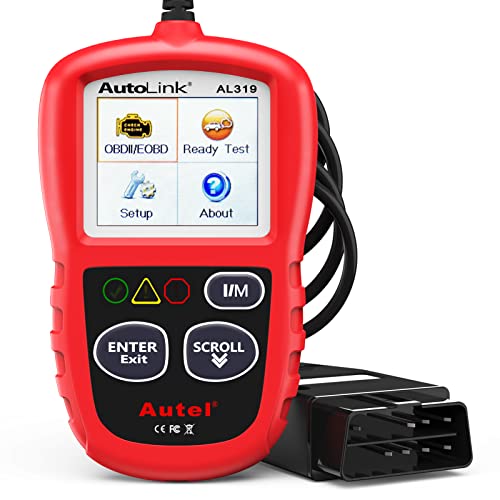
Autel AL319 Review Summary
The Autel AL319 is a practical choice for drivers who mainly want to read and clear fault codes, check live data, review freeze frame information, and verify I/M readiness before a trip or inspection.
It fits best as a simple home diagnostic tool for end users and DIYers who do not need advanced bidirectional features or workshop-level depth.
The big advantage here is clarity.
Autel positions the AL319 as a plug-and-play reader with a simple interface, one-click I/M readiness, a TFT color display, built-in speaker, LED indicator, and no batteries required.
That combination makes it easier to keep in the glove box or garage and use quickly when a warning light appears.
Review Scorecard
| Category | Score | Rationale |
|---|---|---|
| Ease of use | 9/10 | The listing emphasizes plug-and-play operation and a simple interface for non-experts. |
| Core diagnostics | 8/10 | It reads and clears DTCs, looks up codes, and shows live data and freeze frame info. |
| Everyday convenience | 8/10 | One-click I/M readiness, speaker, LED indicator, and no batteries improve quick checks. |
| Vehicle coverage | 8/10 | It supports post-1996 OBD II vehicles and multiple common makes and protocols. |
| Buyer fit | 9/10 | Strong match for DIY drivers who want basic fault-code visibility without complexity. |
| Advanced capability | 4/10 | The listing points to basic diagnostic use, not deeper service functions or pro workflows. |
If your goal is to get a clean answer fast when the CEL comes on, this is the kind of scanner that can earn its keep.
It is less attractive for advanced mechanics who expect broad service coverage, but that is not the audience Autel is targeting.
Key Features and Specifications of Autel AL319
The AL319 is built around the essentials.
According to the listing, it can read and clear diagnostic trouble codes, look up DTCs, display live data, show freeze frame data, review I/M readiness, and view vehicle information.
Those are the core functions most car owners actually use when they want to understand a warning light.
It is designed for OBD II vehicles after 1996, which covers a wide range of common passenger cars from brands such as Toyota, Nissan, Honda, and Ford.
Autel also says it supports seven languages, including English, French, and Spanish, which matters if the scanner is shared in a household or used by a multilingual buyer.
Other notable details from the product record:
| Feature | Evidence from listing | Why it matters |
|---|---|---|
| Vehicle compatibility | Post-1996 OBD II vehicles | Matches the broad modern-car use case most buyers care about. |
| Code functions | Read, clear, and look up DTCs | Helps identify a problem and confirm whether a reset made sense. |
| Live data | Supported | Useful for watching sensor behavior rather than just reading stored codes. |
| Freeze frame | Supported | Gives context for what the car was doing when the fault set. |
| I/M readiness | One-click support | Helpful before emissions testing or routine checks. |
| Interface | TFT color display, built-in speaker, LED indicator | Makes status easier to see and hear at a glance. |
| Power | No batteries needed | Removes one more maintenance item and keeps the tool ready. |
| Support | 12-month warranty and lifetime free updates | Adds reassurance for a tool that may sit unused until needed. |
The product positioning is also clear.
Autel describes the AL319 as suitable for end users and DIYers, not as a complicated professional platform.
That makes the feature set feel coherent rather than sparse: it gives you the everyday information that matters most without trying to be everything at once.
Pros and Cons of Autel AL319
Pros
- Simple plug-and-play operation lowers the barrier for first-time users.
- Reads, clears, and looks up trouble codes, which covers the most common check-engine tasks.
- Live data and freeze frame support add useful context beyond a basic code reader.
- I/M readiness is a strong practical feature for inspection prep.
- No batteries means less upkeep and fewer surprises when you need it.
- Multiple language support broadens usability across households and regions.
Cons
- The listing does not position it as a deep diagnostic or service-tool solution.
- Buyers who want advanced reset functions or expanded workshop features will likely outgrow it.
- The simple interface is a strength, but it also signals that this is a basic-reader category product rather than a multi-system scanner.
In plain terms, the AL319 looks strong on everyday usefulness and limited on ambition.
That is not a flaw if you want basic diagnosis; it is a drawback only if you are shopping for a more capable garage tool.
Who Should Buy Autel AL319?
Buy the Autel AL319 if you are the type of driver who wants a quick answer when the check engine light appears.
It is a fit for owners who want to read codes themselves before visiting a shop, confirm whether a fault cleared, or check readiness status before an inspection.
It also makes sense for households with one or two OBD II vehicles and for DIYers who prefer a dedicated scanner over an app-only workflow.
The no-battery design and straightforward controls make it especially practical to keep around for occasional use.
You should probably skip it if you are shopping for a more advanced diagnostic platform.
If you need deeper system access, broader reset coverage, or a tool that behaves more like professional shop equipment, the AL319’s basic-reader focus will feel limiting.
Best fit: drivers, home mechanics, and first-time scanner buyers who want easy diagnostics.
Skip it if: you need advanced service functions or multi-system workshop depth.
Diagnostic Use Cases for Autel AL319
Check-Engine Troubleshooting
The AL319 is most valuable when a warning light appears and you want to identify the code quickly.
Reading and clearing DTCs, then looking up the fault, is the core workflow the listing supports, and that is usually enough to decide whether a problem looks urgent or informational.
Emissions and Readiness Checks
One-click I/M readiness is a practical feature for people who need to know whether a vehicle is prepared for an emissions test.
It also helps after repairs or a reset, because you can see whether the monitor status is moving in the right direction.
Context From Live Data and Freeze Frame
Live data and freeze frame are the features that move the AL319 beyond the most basic code readers.
Live data helps you watch how the car is behaving now, while freeze frame gives a snapshot of what happened when the code set.
That extra context can help narrow down whether a problem is intermittent, sensor-related, or tied to a specific operating condition.
Everyday Ownership and Storage
The AL319’s physical design choices matter because this is a tool many people will only use a few times a year.
A color display, speaker, LED indicator, long cable, and no-battery design all support that occasional-use pattern.
It seems made for the glove box, garage shelf, or center console, not for constant bench use.
Alternatives to Autel AL319
If you want a similar Amazon-sold scanner but with a different balance of simplicity and depth, these are credible alternatives to compare:
The AL329 is the closest sibling to compare because it sits in the same straightforward scanner family.
BlueDriver is the better-known app-based path if you want phone-centric convenience and are comfortable with that workflow.
ANCEL AD310 is the classic budget-style code reader comparison point, while FOXWELL NT301 is worth a look if you want another established basic scanner brand with a familiar feature set.
Is Autel AL319 Worth It?
Yes, if your goal is to keep a reliable, easy-to-use scanner around for basic diagnostics, code clearing, readiness checks, and live-data snapshots.
The Autel AL319 is worth it for drivers who value simplicity and practical fault-code visibility more than advanced repair functions.
It is not the right pick for everyone, and that is mostly because of scope rather than quality.
If you only need a clean, approachable OBD2 reader for common car-owner tasks, this looks like a sensible buy.
If you want a deeper diagnostic platform, look higher in Autel’s line or compare it against more advanced alternatives.