
If you need one hitch setup that can handle different trailer couplers without swapping hardware, this adjustable tri-ball trailer hitch is built around that problem.
It is aimed at buyers who want a 2-inch receiver solution with multiple ball sizes, height correction, and built-in theft deterrence.
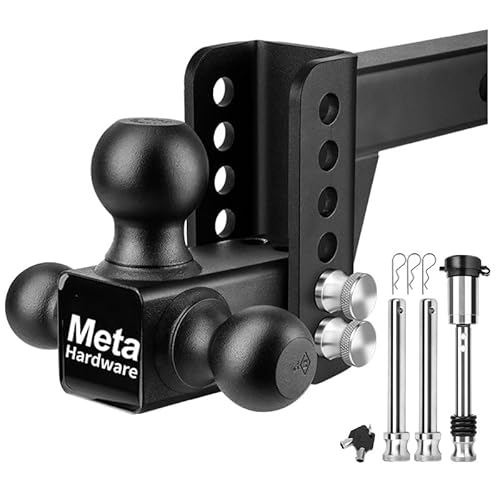
Adjustable Tri-Ball Trailer Hitch Review Summary
This Adjustable Trailer Hitch is a sensible choice for truck, SUV, RV, and boat owners who want flexibility more than a specialty look.
The strongest case for it is simple: it combines a 2-inch receiver fit, a 4-inch drop/rise range, tri-ball compatibility, and anti-theft locking hardware in one setup, which reduces the need to carry extra mounts or swap parts before every tow.
It makes the most sense for buyers who tow more than one trailer type or who need to level a trailer behind a lifted vehicle.
The tradeoff is equally clear: this is a heavy-duty utility part, so the value comes from fit, adjustability, and security features rather than refinement or light weight.
Review Scorecard
| Category | Score | Why it matters |
|---|---|---|
| Receiver fit | 9/10 | Built for standard 2-inch receivers, which covers a very common tow setup. |
| Adjustability | 9/10 | The 4-inch drop/rise range helps correct trailer height mismatch. |
| Ball versatility | 10/10 | Three ball sizes cover 1-7/8″, 2″, and 2-5/16″ couplers. |
| Towing confidence | 8/10 | The 12,500-lb GTW claim suggests serious utility for heavier towing needs. |
| Durability | 8/10 | Forged steel and a powder-coated finish point to hard-use construction. |
| Security | 9/10 | The included anti-theft hitch pin locks add real convenience and deterrence. |
| Everyday convenience | 8/10 | One mount handles multiple trailers, but the rugged build is not optimized for portability. |
Key Features and Specifications of Adjustable Trailer Hitch
The core appeal here is straightforward: one hitch can cover several towing situations.
The listing describes a standard 2-inch receiver fit, a 4-inch precision adjustment range in 1-inch increments, and tri-ball compatibility for 1-7/8″, 2″, and 2-5/16″ couplers.
That combination makes the hitch more adaptable than a single-ball mount and easier to live with if you switch between trailers.
The 12,500-lb GTW claim places it firmly in the heavy-duty category.
That does not mean every tow will approach that limit, but it does tell buyers the hitch is meant for real work rather than light-duty errands.
The forged steel construction and reinforced stiffener rib are also important because the product is positioned as a utility tool for trucks, RVs, farm use, and rougher conditions.
The finish matters too.
The black powder coating is presented as corrosion-resistant and suited to salt, weather, and other harsh environments.
For buyers who leave a hitch installed often, that is a practical feature rather than a cosmetic one.
The package also includes anti-theft pin locks, which reduce the need to buy separate security hardware after the fact.
Key points at a glance:
- Standard 2-inch receiver compatibility
- 4-inch drop and rise range
- Adjustment in 1-inch increments
- Tri-ball sizes: 1-7/8″, 2″, and 2-5/16″
- 12,500-lb GTW claim
- Forged high-strength steel construction
- Reinforced stiffener rib
- Black powder-coated finish
- Included anti-theft hitch pin locks
Pros and Cons of Adjustable Trailer Hitch
Pros
- One hitch covers three common ball sizes, so it reduces hardware clutter.
- The adjustable height range is useful for lifted trucks and uneven trailer setups.
- The included locking hardware adds value and convenience.
- The forged steel build and powder coating suggest a product made for repeated towing.
- It is a strong fit for buyers who want one mount to serve multiple trailers.
Cons
- The rugged design is about function, not compactness or light weight.
- Buyers who only tow one trailer size may not need tri-ball versatility.
- Heavy-duty claims are useful, but they still depend on correct receiver, ball, and vehicle matching.
- The feature set is strongest for utility towing, not for buyers prioritizing a minimalist setup.
Who Should Buy Adjustable Trailer Hitch?
This hitch is best for people who tow different trailers often enough that ball swapping becomes annoying.
If you move between a utility trailer, a camper, or a boat trailer, the tri-ball layout is the main reason to consider it.
It is also a good fit for buyers who need to correct trailer height behind a lifted truck or a vehicle with a nonstandard stance.
It should also appeal to buyers who want a more complete setup out of the box.
The anti-theft locks are a practical bonus, especially if the hitch stays on the vehicle or is parked in public places.
For someone outfitting a work truck, farm vehicle, or RV tow rig, the convenience of having one durable mount can outweigh the extra bulk.
This is less compelling for drivers who tow lightly and rarely change trailers.
If you only need one ball size, do not need drop/rise adjustment, and do not care about locking hardware, a simpler fixed mount may be the cleaner buy.
The same goes for buyers who prefer the lightest possible hitch rather than a feature-rich heavy-duty unit.
Towing and Fit Analysis of Adjustable Trailer Hitch
Receiver and Vehicle Fit
The key fit point is the 2-inch receiver.
That keeps the hitch in a common category and makes it relevant to many trucks and SUVs.
The product is clearly not trying to be universal in the abstract; it is aimed at a specific receiver size that many buyers already have.
Height Correction and Trailer Leveling
The 4-inch drop/rise range is one of the most useful parts of the design.
If a tow rig sits higher than the trailer tongue, or if a lifted truck throws off the angle, the adjustment helps bring the trailer closer to level.
That matters because correct height setup is part of safer, more stable towing.
Ball Selection and Trailer Swaps
The tri-ball layout solves a common annoyance: different trailers usually mean different coupler sizes.
Having 1-7/8″, 2″, and 2-5/16″ options on the same mount makes the hitch more efficient for mixed-use owners.
It is especially practical when a tow vehicle is asked to do more than one job.
Durability and Security
Forged steel, a stiffener rib, and a powder-coated surface all point toward durability-first design.
The added pin locks matter because the hitch is not just a wear item; it is also equipment worth protecting.
Together, those details make the product feel oriented toward real storage, real weather, and real use rather than occasional fair-weather towing.
Alternatives to Adjustable Trailer Hitch
If you want similar utility but a different design or brand direction, a few common Amazon search options are worth comparing:
- CURT adjustable trailer hitch
- BulletProof Hitches adjustable ball mount
- Weigh Safe adjustable trailer hitch
- B&W Trailer Hitches adjustable hitch
These alternatives are worth checking if you want a different balance of finish, adjustment style, or brand reputation.
The main comparison point is whether you need the same tri-ball convenience and locking hardware, or whether a simpler adjustable mount is enough.
Compare similar products on Amazon
Is Adjustable Trailer Hitch Worth It?
For the right buyer, yes.
If you need a 2-inch receiver hitch with tri-ball flexibility, a 4-inch drop/rise range, and included locking hardware, this is a strong utility-focused package that solves several towing problems at once.
It is most worth considering when you regularly tow more than one trailer type, need to correct hitch height, or want a more complete setup without buying extra pieces separately.
If your towing is simple and static, a basic fixed hitch may be enough, but for mixed-use towing this one looks like a practical buy.