
VIOFO A229 Pro 4K HDR Dash Cam is a serious dual-channel pick for drivers who want detailed front and rear recording without moving into a clunky fleet-style system.
If you are comparing VIOFO A229 Pro 4K HDR Dash Cam review options, the standout is the mix of 4K front capture, 2K rear capture, and practical everyday controls.
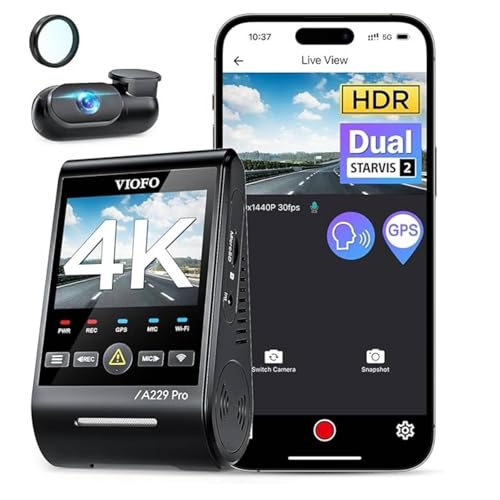
VIOFO A229 Pro Review Summary
The VIOFO A229 Pro 4K HDR Dash Cam is best for buyers who want a high-end everyday dash cam focused on evidence quality, parking protection, and easy operation.
It makes the most sense for commuters, rideshare drivers, road-trippers, and anyone who wants a front-and-rear system with modern sensor hardware instead of a bare-bones recorder.
Verdict: strong buy for drivers prioritizing image detail and parking coverage. The listing points to dual STARVIS 2 sensors, buffered recording, voice control, 5GHz Wi-Fi, and GPS logging, so the package is built around the features people actually rely on after an incident.
Review Scorecard
| Category | Score | Rationale |
|---|---|---|
| Video detail | 9/10 | 4K front and 2K rear recording, backed by STARVIS 2 sensors, should help preserve fine road detail. |
| Night use | 9/10 | HDR and the Night Vision 2.0 positioning suggest a strong focus on difficult low-light driving. |
| Parking protection | 9/10 | Buffered parking modes and automatic event detection are practical for overnight or lot parking. |
| Ease of use | 8/10 | Voice commands and notifications reduce menu diving during daily use. |
| Connectivity | 8/10 | 5GHz Wi-Fi and app control make review and sharing more convenient. |
| Location evidence | 8/10 | Quad-mode GPS adds speed, timestamp, and position context to recorded clips. |
| Overall value fit | 8/10 | It combines several premium features, but the buyer should want those features enough to justify the setup. |
Key Features and Specifications of VIOFO A229 Pro
This model is a dual-camera dash cam built around two STARVIS 2 image sensors: IMX678 for the front camera and IMX675 for the rear camera.
The front records at 4K 2160P, while the rear records at 2K 1440P.
That split matters because the front view usually does the heavy lifting for plate reading, lane context, and incident reconstruction, while the rear view covers tailgating, rear-end contact, and hit-and-run evidence.
Other key listed features include:
- 4K front and 2K rear recording
- STARVIS 2 IMX678 and IMX675 sensors
- HDR for both front and rear recording
- 3 parking modes: Auto Event Detection, Low Bitrate, and Time Lapse
- Buffered parking support that records before and after an event
- 12 voice commands for common controls
- 5GHz Wi-Fi with app control
- Quad-mode GPS support: GPS, Beidou, Galileo, and GLONASS
- Loop recording and emergency lock
- Included CPL filter on the front lens
- 6 m rear cable included
The parking description is especially useful.
The listing says the buffered function can store footage from 15 seconds before to 30 seconds after a detected event.
That is the kind of detail that matters more than marketing language because it determines whether you actually capture the lead-up to a bump, scrape, or door ding.
The GPS system is also more than a checkbox.
A multi-constellation module can improve positioning stability in the situations dash cams see most often, including dense city streets and highway driving.
Paired with the app or a computer, it gives context that can make clips more useful to insurers or during dispute resolution.
Pros and Cons of VIOFO A229 Pro
Pros
- Strong front-and-rear image setup. The 4K/2K split is well matched to how most people use a dash cam.
- Sensor choice is a real differentiator. STARVIS 2 hardware is the headline reason to consider this model over lower-tier kits.
- Parking coverage is thoughtful. Buffered capture and three parking modes make it more useful when the car is unattended.
- Voice control reduces friction. Quick actions like taking a photo or locking a clip are easier without touching the unit.
- 5GHz Wi-Fi is practical. Faster transfers are useful when you need to review or send clips quickly.
- GPS data adds credibility. Speed and location metadata can help frame an event accurately.
Cons
- It is feature-dense. Buyers who want the simplest possible dash cam may not use all of the controls.
- Parking setup may need extra hardware. The listing notes that the HK4 hardwire kit is not included.
- Rear install adds effort. Any dual-camera system takes more time to route and mount than a single front camera.
- The included CPL is useful, but not magical. It can help cut glare, yet it does not replace careful placement and proper setup.
Who Should Buy VIOFO A229 Pro?
Buy this model if you want a dash cam that puts evidence quality first.
The strongest fit is a driver who wants reliable front-and-rear recording, good low-light performance, and parking monitoring that is designed for real incidents rather than just parked-car marketing.
It is also a sensible choice if you like operational convenience.
Voice commands, app control, and GPS data make the system easier to live with over time, especially if you expect to pull clips often.
You should probably skip it if you only want a basic commuter dash cam and do not care about rear coverage, parking modes, or multi-sensor image quality.
The feature set is strong, but the value comes from actually using those extras.
Night, Parking, and Usability in the A229 Pro
Night detail and HDR behavior
The listing leans heavily on HDR and Night Vision 2.0, which tells you the product is tuned for hard lighting conditions rather than only bright daytime footage.
For a dash cam, that is the right priority because the most important clips often happen at dusk, in tunnels, on unlit streets, or under streetlights with harsh contrast.
Buffered parking mode logic
The buffered function is one of the most practical details here because it captures the moments before and after motion is detected.
That matters more than a simple motion-triggered clip, since the lead-up to impact or interference is often the part that explains what happened.
Voice control and daily operation
Twelve voice commands are a meaningful usability feature because they reduce the need to handle the camera while driving.
Taking a photo, locking a clip, or toggling Wi-Fi by voice is the kind of small convenience that adds up if you use the cam every day.
GPS, transfer speed, and review workflow
Quad-mode GPS and 5GHz Wi-Fi support a faster review workflow.
One gives you the context attached to the video, while the other helps you move that video off the camera without wasting time.
For users who expect to preserve clips and share them regularly, that combination is more than cosmetic.
Alternatives to VIOFO A229 Pro
If you want similar Amazon-available options, these are the most credible names to compare:
The VIOFO A129 Pro is the closest comparison if you like the brand but do not need the same level of newer sensor emphasis.
Thinkware U3000 and BlackVue DR770X are stronger comparisons if you are shopping in the premium dual-channel space and care about parking-centric feature sets.
Garmin Dash Cam Live is worth a look if you prefer a simpler ecosystem and connected features over a heavily configurable setup.
Is VIOFO A229 Pro Worth It?
Yes, if you want a premium dual dash cam that is built around evidence quality, low-light performance, and parking protection. The VIOFO A229 Pro 4K HDR Dash Cam is not trying to be the cheapest or simplest option.
It is aiming to be the one that gives you better footage, better context, and better day-to-day control.
If you will use the rear camera, parking modes, GPS data, and voice commands, it is worth serious consideration.
If you will not, a simpler camera will probably do the job for less complexity.