
The 10W/5V Solar Panel Charger is a straightforward way to keep compatible battery cameras topped up without frequent manual charging.
If you want a simple add-on for a Ring battery cam or another supported camera with a Type-C or DC 3.5 x 1.35 port, this review is for you.
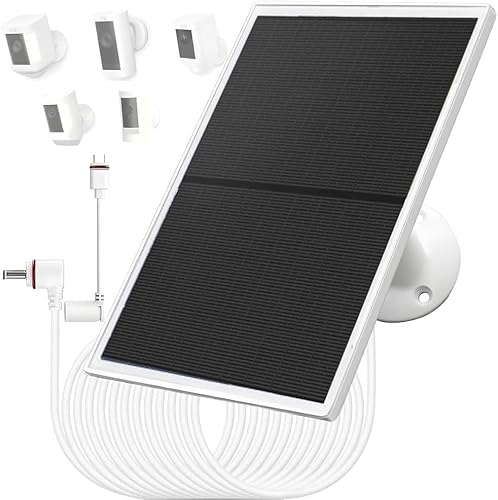
Solar Panel Charger Review Summary
This 10W/5V Solar Panel Charger makes the most sense for buyers who want a low-maintenance charging setup for outdoor battery cameras.
It is built around a clear use case: provide solar power to compatible battery cameras, reduce the need to take the camera down, and give you two connector paths so the panel can work with more than one style of device.
Best fit: owners of compatible Ring battery cameras and other supported rechargeable camera models who can mount a panel in direct sunlight.
Main limitation: it is not for plug-in or wired cameras, and the output depends heavily on available sunlight.
Review Scorecard
| Category | Score | Why it scores this way |
|---|---|---|
| Compatibility | 8/10 | Dual connectors and broad battery-camera support make it flexible for the right devices. |
| Installation flexibility | 8/10 | The 9.8-foot cable and adjustable bracket help with placement and aiming. |
| Weather readiness | 8/10 | IP65 protection and waterproof connector details suit outdoor use. |
| Charging potential | 7/10 | The 10W panel and claimed faster charging are useful, but sunlight remains the deciding factor. |
| Value for convenience | 8/10 | The main value is fewer removals and less manual charging work. |
| Buyer clarity | 7/10 | The listing is specific about supported battery cameras, but buyers still need to check port type carefully. |
For the right camera owner, this is a practical accessory rather than an exciting gadget.
Its strength is convenience: mount it once, aim it well, and let it do the work as long as the weather cooperates.
Key Features and Specifications of Solar Panel Charger
The key selling point is compatibility.
The listing says the panel works with Ring Spotlight Cam Battery, Stick Up Cam Battery, Stick Up Cam Pro Battery, Spotlight Cam Plus Battery, and Spotlight Cam Pro Battery, and it also mentions support for some other built-in rechargeable battery cameras that use Type-C or DC 3.5 x 1.35 charging ports.
It uses a 10W/5V solar panel with monocrystalline silicon and PET materials.
The listing describes an energy conversion rate up to 23% and says the panel can charge up to 60% faster than 5W solar panels.
That is a useful positioning point, but it should be read as a manufacturer claim rather than a promise that every setup will perform the same way.
The included cable is a meaningful part of the product.
A 9.8-foot, 3-meter charging cable gives you room to place the panel where the sunlight is better while keeping the camera mounted where it needs to be.
The adjustable bracket can tilt 90 degrees and rotate 360 degrees, which should help with sun angle and mounting constraints.
The panel is also designed for outdoor exposure.
The listing calls out IP65 dustproof and waterproof protection, plus weather resistance for conditions such as wind, rain, thunderstorms, ice, and snow.
It also lists a working temperature range of -20.5°C to 48.5°C (-5°F to 120°F), which is a useful indicator of how the product is positioned for seasonal outdoor use.
The package includes:
- 1 solar panel
- 1 3m / 9.8ft DC cable
- 1 Type-C charging cable
- 1 360-degree adjustable bracket
- 3 screws
- 3 wall anchors
- 1 instruction manual
The listing also includes an important restriction: it is not compatible with plug-in or wired camera versions.
It is meant for battery-powered cameras only, and it needs enough sunlight to maintain output.
Pros and Cons of Solar Panel Charger
Pros
- Dual connector support improves compatibility for the right battery cameras.
- The long cable makes placement easier than a short, fixed-panel setup.
- The adjustable mount should help you aim for better sun exposure.
- IP65 protection makes it better suited to outdoor installation.
- The panel is aimed at convenience, which is the real reason most buyers want this kind of accessory.
Cons
- It is useless for plug-in or wired cameras.
- Solar charging depends on weather and placement, so performance will vary.
- Buyers need to check port type carefully before ordering.
- The listing spans multiple compatible models, which is helpful, but also easy to misread if you are not careful.
Overall, the pros are practical rather than flashy.
If you need a set-it-and-forget-it power option for a supported battery camera, the feature set is sensible. If you need guaranteed charging in a shaded location, this is the wrong product category.
Who Should Buy Solar Panel Charger?
This panel is a strong match for homeowners who already use a compatible Ring battery camera and want to reduce charging interruptions.
It also fits buyers with other rechargeable outdoor cameras that accept the listed Type-C or DC connector types.
It is especially useful if the camera is mounted in a place that gets regular direct sun and is inconvenient to remove for charging.
In that setup, the cable length and adjustable bracket become real advantages, not just spec-sheet details.
Skip it if your camera is a plug-in model, a wired model, or installed in a spot that rarely gets usable sun.
In those cases, the accessory may be technically interesting but not operationally useful.
If your priority is reducing maintenance, this is a good accessory category to consider.
If your priority is maximum reliability in poor light, you should look at other power solutions instead.
Charging Setup and Outdoor Use
Sunlight Placement Matters
The listing is explicit that the panel needs enough sunlight to work normally.
That means placement is not a cosmetic decision.
A panel mounted in the wrong direction, behind trees, or under a deep overhang will not deliver the same results as one aimed into steady sun.
Connector Choice Is Not Optional
The dual connector approach is useful only if you match the right connector to the right camera.
The product is positioned for Type-C and DC 3.5 x 1.35 charging ports, so buyers should confirm the port on their device before ordering.
That simple check is probably the most important buying step here.
The Bracket Adds Practical Flexibility
The included bracket is not just a bonus accessory.
A 90-degree tilt range and 360-degree rotation help you work around awkward walls, fences, or soffits.
For outdoor camera setups, those small mounting details often matter as much as the panel itself.
Weather Resistance Is Part of the Value
IP65 protection and the waterproof connector design make this panel more believable as a year-round outdoor accessory.
The listing also names a broad temperature range, which reinforces the intended use case.
Even so, weather resistance is not a substitute for good placement, because cloudy or rainy conditions still reduce available output.
Alternatives to Solar Panel Charger
If you want a similar accessory but need to compare ecosystem options, these are the most credible places to look on Amazon:
The right alternative depends on your camera brand and connector type.
If you already own a Ring battery camera, staying inside the Ring ecosystem may simplify compatibility.
If your camera is another rechargeable model, a brand-matched solar panel may be the safer path.
Is Solar Panel Charger Worth It?
For the right buyer, yes.
The 10W/5V Solar Panel Charger is worth considering if you own a compatible battery camera, can mount the panel in real sunlight, and want to reduce how often you manually recharge the device.
Its value comes from practical details: dual connector support, a long cable, an adjustable bracket, and weather-ready construction.
Those are the features that matter in a real camera setup.
It is not worth it if your camera is wired, plug-in, or installed where sunlight is weak.
In that case, the product cannot solve the main problem.
Bottom line: buy it if you need a solar maintenance reducer for a supported battery camera and you can give it sun exposure.
Skip it if your setup does not match the compatibility and placement requirements.