
VDIAGTOOL VD10 OBD2 Scanner review is really about one thing: making basic car diagnostics less intimidating.
If you want a simple, plug-in code reader for common check-engine jobs, this model fits that brief well.
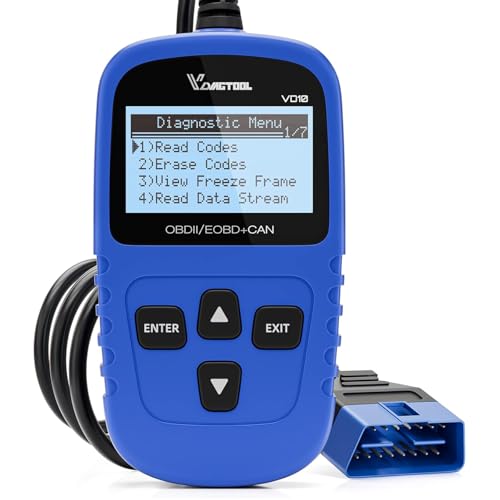
VD10 OBD2 Scanner Review Summary
The VDIAGTOOL VD10 OBD2 Scanner is best for drivers who want a no-fuss way to read codes, clear codes after a repair, check I/M readiness, and see basic live data without moving into a more expensive scan tool.
It is also a sensible buy for used-car shoppers who want to verify vehicle information quickly and for DIY owners who need a clearer view of what the car is reporting before they decide whether to visit a shop.
What makes it appealing is not advanced depth.
It is the combination of the core functions most people actually need, a built-in code database with definitions on-screen, and a simple plug-and-play workflow.
If your goal is to handle routine OBD2 jobs with minimal setup, the VD10 OBD2 Scanner looks well matched to that use case.
Review Scorecard
| Category | Score | Buyer-focused rationale |
|---|---|---|
| Ease of use | 9/10 | Plug-and-play design, no batteries or charger needed, and a 2-line LCD help keep it simple. |
| Core diagnostic value | 8/10 | Reads and clears codes, shows definitions, and covers freeze frame plus live data. |
| Readiness-check usefulness | 9/10 | I/M readiness support is especially helpful for inspection prep. |
| Compatibility breadth | 8/10 | Supports all OBDII protocols and is listed for most 1996+ US, 2006+ EU, and 2009+ Asian vehicles. |
| Data visibility | 7/10 | Useful basics are covered, but the screen and feature set are intentionally limited. |
| Buyer confidence | 8/10 | Vehicle information, including VIN and calibration details, adds practical value for owners and used-car buyers. |
| Overall value for DIY use | 8/10 | Strong fit if you need everyday code-reader tasks more than professional-level diagnosis. |
Key Features and Specifications of VD10 OBD2 Scanner
The VDIAGTOOL VD10 OBD2 Scanner focuses on the standard jobs that matter most in everyday diagnostics.
According to the listing, it can read generic and manufacturer-specific trouble codes, including pending codes, and it displays DTC definitions on the device so you do not have to look them up separately.
It also supports live data and freeze frame.
That matters because live sensor data can help you understand what the engine is doing right now, while freeze frame preserves the conditions present when a fault was logged.
For intermittent problems, that can be more useful than a simple warning light alone.
Other notable functions include:
- Read and clear trouble codes
- Show DTC definitions from the built-in database
- View live data
- Retrieve freeze frame data
- Check I/M readiness status
- Retrieve vehicle information such as VIN, Calibration ID(s), and Calibration Verification Nos. (CVNs)
The product is listed as compatible with all OBDII protocols, including CAN, ISO9141, KWP2000, J1850 PWM, and J1850 VPW.
The listing also says it is compatible with 99% of OBDII-compliant vehicles, including post-1996 US-based cars, post-2006 EU-based cars, and post-2009 Asian-based cars.
It is intended for 12V cars, SUVs, and light trucks.
Hardware-wise, the listing points to a clear 2-line LCD screen with white backlight and contrast adjustment.
It is also plug-and-play, with no batteries or charger required.
Those details matter because this is a tool designed for quick checks in the driveway, not a tablet-style diagnostic platform you need to configure first.
Pros and Cons of VD10 OBD2 Scanner
Pros
- Easy to use for first-time DIYers and occasional users
- Reads and clears codes without needing online lookup for every fault
- Built-in code definitions save time during basic troubleshooting
- I/M readiness support is useful before an emissions or inspection test
- Vehicle information features can help when checking a used car
- Freeze frame and live data add context beyond a simple code reader
Cons
- The compact LCD limits how much information you can review at once
- It is built for standard OBD2 tasks, not deep brand-specific diagnostics
- The feature set is practical, but not aimed at advanced shop-level users
- Owners who want graph-heavy data analysis will likely outgrow it
The short version is that the VD10 OBD2 Scanner is strong where most casual buyers need it to be strong: clarity, speed, and basic fault-code handling.
It is not trying to be a premium diagnostic tablet, and that restraint is part of the appeal.
Who Should Buy VD10 OBD2 Scanner?
The VDIAGTOOL VD10 OBD2 Scanner makes the most sense for three kinds of buyers.
First are DIY drivers who want to understand a check-engine light before paying a shop for a simple scan.
Second are owners who want to confirm whether a code has been cleared and whether readiness monitors are set before an inspection.
Third are used-car shoppers who want a lightweight tool for checking vehicle information and reading stored codes during a pre-purchase look.
It also suits people who prefer simple tools over app-based gadgets.
If you want a direct device with a screen, built-in code lookups, and no battery management, that is exactly the lane this scanner occupies.
You should probably skip it if you are looking for advanced module coverage, manufacturer-specific bidirectional controls, or richer graphing and live-analysis features.
In that case, a more advanced scan tool would be a better long-term fit.
How the VD10 OBD2 Scanner Handles Everyday Diagnostics
Reading and Clearing Codes
The most important job here is still the basic one: identify the fault code, understand what it means, and clear it after the repair.
The VD10 OBD2 Scanner does this with on-screen code definitions, which reduces friction for people who do not want to bounce between a code reader and a phone search.
Readiness Checks and Inspection Prep
I/M readiness support is a meaningful feature because emissions and inspection checks often depend on whether monitors have completed after a reset.
This is one of the most practical reasons to buy a scanner like this, especially if you perform your own repairs and want to verify the car is ready before heading out.
Freeze Frame and Live Data
Freeze frame helps you see the snapshot captured when the fault occurred, while live data gives a basic window into current sensor behavior.
That combination is especially useful when a problem is intermittent or when a check-engine light appears and disappears without an obvious cause.
Vehicle Information for Verification
The ability to retrieve VIN, Calibration ID(s), and CVNs adds extra confidence when you are checking whether the ECU matches a vehicle or validating information on a used car.
It is a small feature set, but one with real practical value.
Alternatives to VD10 OBD2 Scanner
If you want a similar Amazon-ready alternative, consider the Autel AutoLink series for a slightly broader diagnostic reputation and straightforward handheld use.
Search Amazon for Autel AutoLink OBD2 scanner.
Another common alternative is the BlueDriver Bluetooth Pro OBD2 Scan Tool, which appeals to buyers who prefer a phone-based workflow and app-driven reporting.
Search Amazon for BlueDriver OBD2 scan tool.
For shoppers who mainly want a simple code reader with a familiar handheld format, the Innova OBD2 code reader line is also worth comparing.
Search Amazon for Innova OBD2 code reader.
If your priority is easier everyday code reading, the VDIAGTOOL VD10 OBD2 Scanner remains competitive because it keeps the feature set focused and the workflow simple.
If you want more software depth or app integration, the alternatives above may be a better fit.
Is VD10 OBD2 Scanner Worth It?
Yes, if you want a basic handheld OBD2 scanner that covers the jobs most drivers actually use.
The VDIAGTOOL VD10 OBD2 Scanner is worth considering for code reading, code clearing, readiness checks, freeze frame viewing, and simple live data in a compact, no-setup format.
It is not the right choice for someone who wants advanced diagnostics or a richer interface, but that limitation is also what keeps it approachable.
For DIY owners, inspection prep, and used-car checks, the VD10 OBD2 Scanner is a practical buy.