
Choosing the right charge controller is one of the easiest ways to protect your batteries and get more reliable performance from a small solar setup. The best models for first-time buyers balance compatibility, clear displays, and straightforward installation.
In this roundup, we focus on solar charge controllers for beginners that are practical, safe, and easy to size for common 12V and 24V systems.
Best 10 Solar Charge Controllers for Beginners Picks for 2026
Bluetooth MPPT Upgrade
Victron SmartSolar MPPT 100V 50A

- MPPT helps maximize available solar power.
- Bluetooth app shows data, history, and settings.
- Supports 12/24V systems and load disconnect control.
Best For: Beginners who want app-based monitoring and room to expand
Easy 12V Starter

- LED indicators keep charging status easy to read.
- Supports LiFePO4, AGM, gel, and flooded batteries.
- Compact 12V controller with built-in safety protections.
Best For: Beginners building a small 12V RV, boat, or off-grid setup
Small Bluetooth MPPT
Victron SmartSolar MPPT 75V 15A

- Compact 15A MPPT controller for smaller systems.
- Bluetooth app shows live data and 30-day history.
- Supports 12/24V systems with intelligent load output.
Best For: Beginners with smaller systems who want efficient charging and app monitoring
Budget LCD Basic
30A PWM Solar Charge Controller

- Automatic 12V/24V adaptation simplifies setup.
- LCD display shows status and settings clearly.
- Best with lead-acid batteries only.
Best For: Beginners who want a simple, affordable controller for lead-acid systems
Compact MPPT Pick for 12V Starter Systems
SUNAPEX MPPT Solar Charge Controller 12V 10A
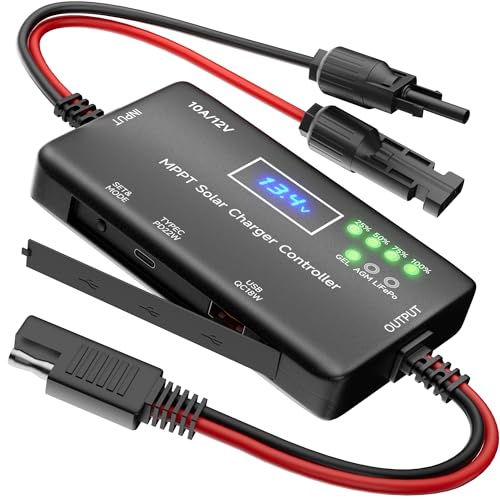
- 12V-only MPPT controller with smart 4-stage charging
- LCD and LED indicators simplify setup and monitoring
- USB and Type-C outputs add extra convenience
Best For: Beginners building a compact 12V solar system
Reliable PWM Choice for RV Basics
Renogy Wanderer 10A PWM Solar Charge Controller
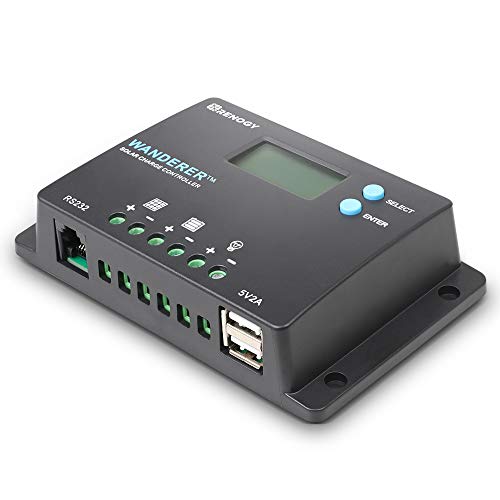
- 12V/24V PWM controller with automatic battery recognition
- LCD display and multiple load modes for flexibility
- Supports AGM, Gel, Flooded, and Lithium batteries
Best For: First-time users who need a dependable RV or marine controller
High-Output Auto-Detect MPPT Option
100A MPPT Solar Charge Controller with Auto Parameter LCD Display

- 12V/24V auto-recognition reduces setup complexity
- LCD display and adjustable settings improve usability
- Dual USB ports and safety protections add convenience
Best For: Beginners planning a larger system with room to expand
Premium MPPT Pick
Renogy Rover 40A 12V/24V Auto MPPT Controller

- MPPT charging with up to 99% tracking efficiency
- Works with Gel, AGM, Flooded, and Lithium batteries
- App and LCD monitoring for easier setup and review
Best For: Beginners who want a capable MPPT controller with room to expand
Simple Budget Choice
30A PWM Solar Controller with LCD and USB

- Automatic 12V/24V operation keeps setup simple
- LCD display helps with status and parameter changes
- Supports OPEN, AGM, and GEL lead-acid batteries
Best For: First-time users who want a straightforward lead-acid controller
High-Output Value Pick
100A MPPT Controller with LCD and USB

- Automatic recognition for 12V to 48V systems
- Detailed LCD readout helps with monitoring and troubleshooting
- Works with Seal, GEL, Flooded, and LiFePO4 batteries
Best For: Beginners planning a larger setup who want flexible battery support
Bluetooth MPPT Upgrade – Victron SmartSolar MPPT 100V 50A
If you’re comparing solar charge controllers for beginners, this Victron SmartSolar MPPT is a strong step-up option for users who want app-based monitoring and efficient charging. It uses MPPT tracking to maximize available solar power, includes Bluetooth connectivity through VictronConnect, and can synchronize with other SmartSolar controllers in larger setups.
Best For: Beginners who want a high-end Bluetooth MPPT controller for expandable 12/24V systems.
Pros:
- MPPT tracking helps capture maximum power, including in partial shade.
- VictronConnect app provides real-time data, history, settings, and firmware updates.
- Intelligent load output can disconnect loads automatically if battery voltage drops too low.
- Can synchronize with other SmartSolar MPPT controllers for system-wide optimization.
Cons:
- No built-in display, so setup and monitoring rely on the app.
- More advanced than a basic starter controller if you only need a simple small system.
This model makes the most sense if you want beginner-friendly app visibility but also expect to grow your system later. Its smart features are useful, but the controller is clearly aimed at users who want more control than a basic plug-and-play unit.
Easy 12V Starter – Renogy Wanderer Li 30A PWM
For buyers shopping solar charge controllers for beginners, the Renogy Wanderer Li keeps things approachable with LED status lights, automatic battery-type handling, and a compact footprint. It is designed for 12V systems, supports LiFePO4, AGM, gel, and flooded batteries, and includes built-in protections for common wiring and charging mistakes.
Best For: Beginners building a compact 12V RV, boat, or off-grid system who want a straightforward PWM controller.
Pros:
- Automatic charging curves and LED indicators make it easier to understand charging status.
- Supports multiple battery types, including lithium and lead-acid chemistries.
- Compact size fits tight spaces in RV and marine installations.
- Includes protections against reverse polarity, overload, short circuits, and overcharging.
Cons:
- Limited to 12V systems, so it is not as flexible as dual-voltage models.
- PWM design is simpler than MPPT for maximizing panel output.
This is a practical starter pick if you want a controller that is easy to install, easy to read, and built for smaller 12V setups. The Bluetooth module is sold separately, so keep that in mind if app monitoring matters to you.
Small Bluetooth MPPT – Victron SmartSolar MPPT 75V 15A
If you want solar charge controllers for beginners without giving up smart features, this smaller Victron SmartSolar MPPT is a good entry point. It offers Bluetooth app access, MPPT charging for better power harvest, and the same practical monitoring tools found in larger SmartSolar models, but in a more compact 15A format.
Best For: Beginners with a smaller 12/24V setup who want Bluetooth monitoring and efficient MPPT charging.
Pros:
- MPPT charging helps extract more usable power, especially when panels are partly shaded.
- VictronConnect app gives access to real-time data, history, settings, and firmware updates.
- Compact 15A size is suitable for smaller systems.
- Can power loads directly and disconnect them if battery voltage gets too low.
Cons:
- No full display, so app use is the main way to monitor and configure it.
- 15A output is better for smaller systems than larger expansion plans.
This controller is a sensible choice if you want the benefits of MPPT and Bluetooth in a smaller package. It is especially appealing for beginners who prefer app-based setup and monitoring instead of a more basic display-only controller.
Budget LCD Basic – 30A PWM Solar Charge Controller
This upgraded 30A PWM unit is one of the more straightforward solar charge controllers for beginners who want a display, automatic voltage handling, and simple battery support. It works with 12V and 24V systems, shows operating status on an LCD, and includes USB charging plus multiple built-in safety protections.
Best For: Beginners who want an affordable LCD controller for basic lead-acid solar systems.
Pros:
- Automatic 12V/24V adaptation reduces setup hassle.
- LCD display makes system status and settings easier to see.
- Includes dual USB output for charging small devices.
- Built-in protections help guard against overcharge, reverse polarity, and short circuits.
Cons:
- Only suitable for lead-acid batteries, not lithium or NiMH.
- PWM design is less efficient than MPPT for higher-performance systems.
For a basic home, RV, or small off-grid setup, this controller covers the essentials without adding complexity. The clear LCD and automatic voltage detection make it approachable, but battery compatibility is limited to lead-acid types.
Compact MPPT Pick for 12V Starter Systems – SUNAPEX MPPT Solar Charge Controller 12V 10A
If you’re comparing solar charge controllers for beginners, this SUNAPEX unit is a straightforward 12V MPPT option for small setups. It focuses on basic, practical features like clear LCD status, plug-and-play SAE connectors, and built-in protections, while still supporting common battery types such as AGM, Gel, Lead-Acid, and LiFePO4.
Best For: Beginners building a compact 12V solar system who want easy setup and simple monitoring.
Pros:
- MPPT charging with smart 4-stage charging for better battery care
- LCD screen and LED indicators make system status easy to check
- USB and Type-C output ports add direct device charging
- Multiple protections, including reverse polarity, short-circuit, and over-temperature
Cons:
- Only suitable for 12V batteries
- Not compatible with solar panels that already have built-in controllers
- Must be wired with correct polarity
As a beginner-friendly controller, this model keeps the feature set focused without feeling overly basic. The biggest limitation is its 12V-only design, but for a small portable or starter system, that also makes it easier to match the right components.
Reliable PWM Choice for RV Basics – Renogy Wanderer 10A PWM Solar Charge Controller
For shoppers searching for solar charge controllers for beginners, the Renogy Wanderer 10A is a practical PWM controller with broad battery support and simple system protection. It offers 12V/24V compatibility, an LCD display, and multiple load control modes, which makes it a flexible starting point for RV, marine, and off-grid projects.
Best For: First-time users who want a dependable PWM controller for RV, marine, or small off-grid builds.
Pros:
- Supports 12V and 24V systems with automatic battery recognition
- 4-stage charging works with AGM, Gel, Flooded, and Lithium batteries
- LCD screen shows voltage, current, and system status
- Built-in protection features and temperature compensation
Cons:
- PWM design is less advanced than MPPT controllers
- 10A output limits it to smaller systems
- Some setup options may be more than a true plug-and-play user needs
This is a solid all-around starter controller if you want something well-known and simple to live with. It does not chase the highest efficiency, but it does cover the essentials cleanly for basic solar setups.
High-Output Auto-Detect MPPT Option – 100A MPPT Solar Charge Controller with Auto Parameter LCD Display
Among solar charge controllers for beginners, this 100A MPPT model stands out for its auto-recognition and simple LCD-based controls. It is designed to reduce setup confusion by detecting 12V or 24V systems, while also offering direct USB charging and built-in safety protections for everyday use.
Best For: Beginners who want a high-capacity controller with automatic voltage detection and easy LCD adjustments.
Pros:
- 12V/24V auto-recognition simplifies installation
- Intuitive LCD display makes settings and performance easy to follow
- Built-in protections help guard against overcharging, short-circuits, and reverse polarity
- Dual USB ports add handy direct-device charging
Cons:
- 100A capacity may be more controller than a small starter setup needs
- Battery-first connection order is required for auto-detection
- Large output rating can be unnecessary for simple beginner systems
This is a good fit if you expect your system to grow and want auto-detection to handle much of the setup work. It is more controller than many beginners need, but the clear display and safety features make it approachable.
Premium MPPT Pick – Renogy Rover 40A 12V/24V Auto MPPT Controller
If you’re comparing solar charge controllers for beginners, this Renogy Rover is a strong step-up option if you want smart charging and detailed visibility from day one. It uses MPPT technology for high tracking efficiency, supports 12V/24V auto-detection, and includes an LCD plus app connectivity for easier monitoring and adjustments.
Best For: Beginners who want a feature-rich MPPT controller for off-grid systems and plan to grow into more advanced settings.
Pros:
- MPPT design with up to 99% tracking efficiency and strong performance in low light or partial shade
- Supports Gel, AGM, Flooded, and Lithium batteries with 12V/24V auto-detection
- Built-in protections cover reverse polarity, overload, short circuit, overcharge, and more
- DC Home App support and RS485 connectivity for real-time data and settings changes
Cons:
- BT-2 for app connectivity is sold separately
- More advanced than a basic starter controller if you only need simple load control
This is a practical choice if you want a beginner-friendly path into MPPT charging without giving up protection or monitoring features. The tradeoff is that it offers more capability than the average entry-level unit, so it makes the most sense when you want room to expand.
Simple Budget Choice – 30A PWM Solar Controller with LCD and USB
For buyers searching for solar charge controllers for beginners, this 30A PWM model keeps the basics simple and affordable. It automatically handles 12V/24V systems, adds an LCD for status checks, and includes dual USB output ports for small device charging.
Best For: First-time users who want a straightforward PWM controller for lead-acid battery setups.
Pros:
- Automatic 12V/24V operation for easier setup
- LCD display makes it easier to read status and adjust settings
- Supports OPEN, AGM, and GEL lead-acid batteries
- Built-in protections include overcurrent, short circuit, reverse connection, and open circuit protection
Cons:
- Not suitable for lithium batteries
- PWM design is less advanced than MPPT options
- Dual USB ports are useful, but the core feature set is still basic
This controller fits a beginner who wants a lower-cost, easy-to-understand unit for common lead-acid systems. It is best when simplicity matters more than maximum charging efficiency.
High-Output Value Pick – 100A MPPT Controller with LCD and USB
If you’re shopping for solar charge controllers for beginners but want extra capacity for a bigger build, this 100A controller offers a lot of features. It automatically recognizes 12V/24V/36V/48V systems, includes an LCD with detailed status data, and supports multiple battery types for flexible setups.
Best For: Beginners planning a larger solar setup who want lots of settings and battery flexibility.
Pros:
- Supports 12V/24V/36V/48V systems with automatic recognition
- LCD shows working mode, battery voltage, PV charging current, temperature, and more
- Compatible with Seal, GEL, Flooded, and LiFePO4 batteries
- Includes protections for over-voltage, over-current, deep discharge, reverse connection, and overheating
Cons:
- The notes state it combines MPPT and PWM technologies rather than being full MPPT
- Feature-heavy interface may be more than a true beginner needs
- No included components are listed in the supplied details
This model makes sense if you want a controller with broad compatibility and lots of display information for troubleshooting. It is less of a pure starter pick and more of a flexible, higher-capacity option for users who expect their system to grow.
How We Picked the Best Solar Charge Controllers for Beginners
For Solar Charge Controllers for Beginners, we prioritized simple setup, clear battery and system labeling, strong protection features, and broad compatibility with common lead-acid and lithium battery types. We also weighed whether the controller is easy to read and whether its current rating makes sense for small to mid-size DIY systems.
Quick Comparison
PWM models are usually the easiest and most affordable choice for basic 12V systems with close-panel wiring. MPPT models cost more, but they convert extra solar voltage into usable charging power more efficiently, which is helpful when panel voltage is higher or the system may grow later. If you want the least complicated path, start with a controller that matches your battery chemistry and voltage exactly.
Key Buying Factors for Solar Charge Controllers for Beginners
Controller Type
PWM is fine for small, budget-friendly setups with compatible panels. MPPT is the better long-term choice when you want better efficiency, more flexible panel wiring, or larger array performance.
Voltage and Amperage
Match the controller to your battery bank voltage first, then size amperage based on your total solar array output. Buying too small can limit charging, while oversizing adds cost without much benefit.
Battery Compatibility
Make sure the controller supports your battery chemistry, especially if you use LiFePO4, AGM, gel, or flooded lead-acid batteries. Beginners should favor models with preset battery modes or automatic parameter detection to reduce setup mistakes.
Display and Controls
An LCD display can make troubleshooting much easier by showing input, charging status, and battery information at a glance. Physical buttons and clearly labeled menus are a plus for first-time users.
Protection Features
Look for safeguards such as overcharge protection, reverse polarity protection, short-circuit protection, and temperature compensation where available. These features help prevent damage during wiring mistakes or changing weather conditions.
Who Should Buy Which Solar Charge Controllers for Beginners?
If you are building a small starter system and want the simplest path, a lower-amperage PWM controller is usually enough. If you plan to expand later, use mixed panel orientations, or want better harvest in variable light, choose an MPPT model. Beginners with lithium batteries should put compatibility and preset support at the top of the list. For most buyers comparing Solar Charge Controllers for Beginners, the best option is the one that fits your battery bank, panel size, and comfort level with setup.