
The right deep cycle battery keeps your trolling motor running consistently without adding unnecessary weight or maintenance to your boat. The best choice depends on your motor’s voltage, desired runtime, available space, and budget.
We compared ten popular marine-ready options, including efficient LiFePO4 batteries, proven AGM models, compact portable batteries, and high-capacity multi-battery setups.
Best 10 Deep Cycle Battery for Trolling Motor Picks for 2026
Budget AGM Pick
Mighty Max ML55-12 55Ah Trolling Motor Battery

- 12V, 55Ah sealed lead-acid battery
- Maintenance-free, spill-proof AGM/SLA design
- Compact option with one-year warranty
Best For: Smaller trolling motors and budget-focused buyers
Smart High-Capacity Lithium
BUKNUWO 12.8V 100Ah LiFePO4 Battery

- 22-pound 100Ah LiFePO4 battery
- Bluetooth 5.0 app monitoring
- 100A BMS and low-temperature protection
Best For: Lithium users wanting high capacity and connected monitoring
Connected Marine Lithium
DC HOUSE 12V 100Ah Bluetooth Battery
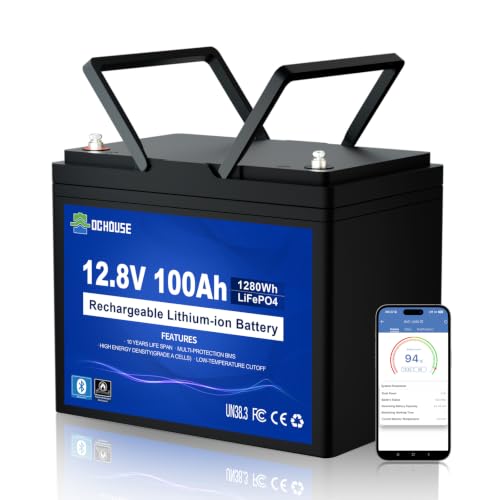
- Bluetooth 5.1 monitoring and fault display
- Low-temperature charging and discharge cut-off
- 100A BMS with up to 15,000 claimed cycles
Best For: Marine users wanting app monitoring and cold-weather protection
Long-Shelf-Life AGM
Renogy 12V 100Ah Deep Cycle Battery

- Maintenance-free 100Ah sealed AGM design
- Below 3% monthly self-discharge at 77°F
- Two-year warranty and broad discharge range
Best For: Stored boats and buyers preferring conventional AGM chemistry
Best Overall
Hey Future 12V 100Ah Bluetooth LiFePO4
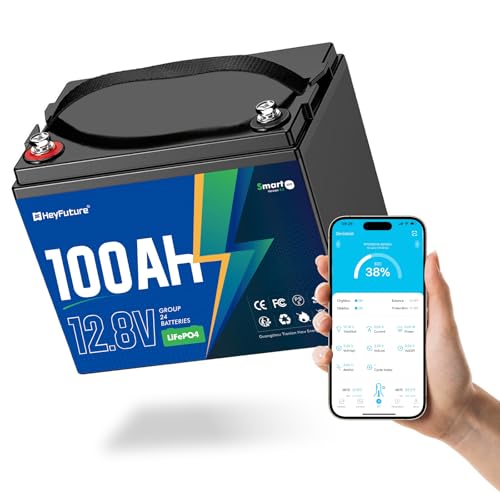
- 100Ah capacity for extended deep-cycle use
- Bluetooth monitoring with protective BMS
- Group 24 design with expansion support
Best For: Boat owners seeking a high-capacity, monitorable lithium battery
Best Compact Option
ECO-WORTHY 12V 20Ah Bluetooth LiFePO4
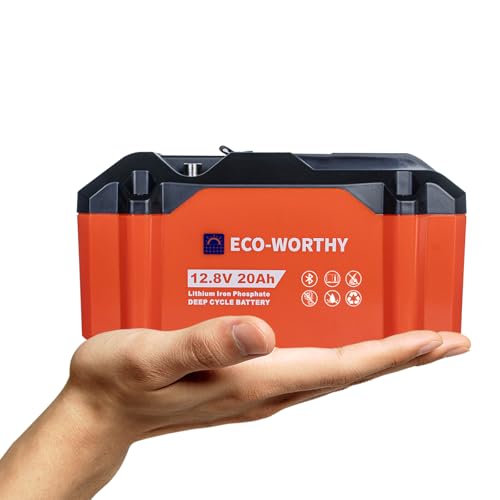
- Lightweight 5.4-pound portable design
- Bluetooth 5.1 real-time monitoring
- Cold-weather and overload protection
Best For: Small kayaks and low-demand fishing or camping setups
Best Two-Battery Value
SUPER EMPOWER 12V 100Ah LiFePO4 2-Pack

- Two 100Ah batteries for expanded storage
- Group 24 drop-in replacement design
- 100A BMS with series and parallel support
Best For: Larger marine systems needing extended auxiliary power
Best Smart-Connected Pick
LiTime 12V 100Ah Bluetooth LiFePO4

- Bluetooth monitoring from a phone
- About 22.2 pounds with Group 31 sizing
- Up to 4,000 cycles at 100% depth of discharge
Best For: Boaters wanting app-based monitoring and lightweight, long-life power
Best Group 24 Replacement
SUPER EMPOWER 12V 100Ah LiFePO4

- Group 24 size with M8 terminals
- 100A BMS with temperature protection
- Supports up to 4S4P expansion
Best For: Owners replacing a compatible lead-acid, AGM, or SLA battery
Best Long-Life Group 31 Option
12V 100Ah LiFePO4 Group 31 Battery

- Group 31 drop-in dimensions
- 24-pound maintenance-free design
- Up to 15,000 claimed cycles at 60% discharge
Best For: Frequent users wanting lightweight, long-life Group 31 power
Budget AGM Pick – Mighty Max ML55-12 55Ah Trolling Motor Battery
Mighty Max Battery 12V 55Ah Power Boat Pontoon Electric Trolling Motor Deep Cycle Battery
Check Price On AmazonIf you need a straightforward deep cycle battery for trolling motor use, the Mighty Max ML55-12 offers a compact 12V, 55Ah sealed lead-acid design. It is maintenance-free, rechargeable, and spill-proof, making it a practical fit for smaller boat setups where simple installation matters.
Best For: Smaller trolling motors and buyers seeking an affordable, compact AGM/SLA battery.
Pros:
- Maintenance-free 12V, 55Ah sealed lead-acid construction
- Spill-proof design can be mounted in various positions
- Resists shocks and vibration, with a one-year manufacturer warranty
Cons:
- Lower 55Ah capacity than the 100Ah options in this roundup
- Battery and screws are included, but no wiring harness or mounting accessories
- Lead-acid construction is heavier than comparable lithium batteries
The Mighty Max is a sensible value choice when you want uncomplicated AGM performance and do not need the longer runtime or lighter weight of a lithium battery.
Smart High-Capacity Lithium – BUKNUWO 12.8V 100Ah LiFePO4 Battery
For anglers wanting a high-capacity deep cycle battery for trolling motor use, the BUKNUWO 12.8V 100Ah LiFePO4 battery combines a lightweight design with app-based monitoring. Its integrated BMS, low-temperature protection, and expandable configuration make it versatile for marine, RV, and off-grid applications.
Best For: Trolling motor users who want lithium efficiency, Bluetooth monitoring, and a 100Ah capacity.
Pros:
- 22-pound LiFePO4 design with a stated 1.28kWh energy capacity
- Bluetooth 5.0 monitoring for state of charge, voltage, current, temperature, and protection status
- 100A BMS with high/low-temperature, overcharge, over-discharge, short-circuit, and overcurrent protection
- Supports series and parallel expansion up to 4S4P
Cons:
- Requires suitable lithium charging equipment
- Bluetooth monitoring range is limited to about 33 feet
- Charging and discharging should be managed within the specified temperature ranges
With its light weight, high usable capacity, and detailed phone monitoring, this BUKNUWO battery is a strong fit for boaters prepared to move from lead-acid to lithium power.
Connected Marine Lithium – DC HOUSE 12V 100Ah Bluetooth Battery
The DC HOUSE 12V 100Ah battery is a purpose-oriented deep cycle battery for trolling motor setups, with Bluetooth 5.1 monitoring and temperature-based charging protection. Its 100A BMS, Group 24-style dimensions, and 23.8-pound weight offer a useful balance of capacity, portability, and marine versatility.
Best For: Boat owners who want a Bluetooth-enabled lithium battery with low-temperature cut-off protection.
Pros:
- Bluetooth 5.1 app displays SOC, voltage, current, cell data, and faults
- Low-temperature protection cuts off charging below 19.4°F and discharging below -4°F
- Class A LiFePO4 cells, 100A BMS, and claimed service life of up to 15,000 cycles
- Supports series or parallel expansion, with up to eight batteries total under the stated configuration limits
Cons:
- Not designed for starting or cranking engines
- Requires a dedicated lithium battery charger
- Its dimensions are about 0.32 inches taller than standard Group 24 specifications
This DC HOUSE model stands out for trolling motor users who value real-time battery information and cold-weather charging safeguards, while its stated three-year service support adds reassurance.
Long-Shelf-Life AGM – Renogy 12V 100Ah Deep Cycle Battery
If you prefer lead-acid simplicity, the Renogy 12V 100Ah AGM is a dependable deep cycle battery for trolling motor, RV, and marine applications. Its sealed construction, low self-discharge rate, and broad discharge temperature range make it well suited to equipment that may sit between outings.
Best For: Buyers who want a maintenance-free AGM battery with strong storage characteristics and conventional lead-acid operation.
Pros:
- 100Ah sealed AGM battery with maintenance-free operation
- Monthly self-discharge rate below 3% at 77°F
- Specified discharge performance from -4°F to 140°F
- Two-year warranty and up to 1,100A maximum discharge current listed
Cons:
- At 63.9 pounds, it is substantially heavier than the lithium alternatives
- AGM chemistry generally offers fewer cycles and less usable capacity than LiFePO4 designs
- Its 13.1-inch length may require more installation space
The Renogy is a practical choice for shoppers who prioritize sealed AGM safety, low storage drain, and familiar lead-acid compatibility over minimum weight.
Best Overall – Hey Future 12V 100Ah Bluetooth LiFePO4
If you need a deep cycle battery for trolling motor use, this Hey Future 12V 100Ah LiFePO4 model offers substantial capacity in a lighter package than typical lead-acid options. Its Bluetooth-enabled BMS provides protection from overcharging, over-discharging, overcurrent, overheating, and low-temperature operation.
Best For: Boat owners who want a high-capacity, lightweight battery with Bluetooth monitoring and expansion options.
Pros:
- 100Ah capacity supports extended deep-cycle use.
- Bluetooth and intelligent BMS protection help monitor and manage the battery.
- Group 24 sizing is designed as a replacement for many lead-acid, AGM, and SLA batteries.
- Supports up to four batteries in series or parallel for larger energy systems.
Cons:
- May not work with some older lead-acid charging systems without upgrades.
- Series and parallel installations should follow the instructions and may require professional setup.
With its combination of capacity, marine-oriented protection, and expandable configuration, this is a strong all-around choice for trolling motors and other 12V boat systems.
Best Compact Option – ECO-WORTHY 12V 20Ah Bluetooth LiFePO4
For smaller boats, kayaks, and portable setups, this ECO-WORTHY model is a compact deep cycle battery for trolling motor accessories, fishfinders, and other modest loads. Its 20Ah capacity keeps the unit light, while Bluetooth 5.1 lets you check voltage, current, capacity, and battery lifespan from a phone.
Best For: Kayaks, small fishing setups, fishfinders, camping gear, and other low-demand marine applications.
Pros:
- Compact 5.4-pound design with an ergonomic carrying grip.
- Bluetooth 5.1 supports real-time battery monitoring.
- Built-in 20A BMS protects against overcharge, deep discharge, overload, overheating, and short circuits.
- Low-temperature cutoffs help protect charging and discharging in cold conditions.
Cons:
- 20Ah capacity is substantially smaller than full-size trolling motor batteries.
- The DC output is limited to 5A.
- The 5.5 x 2.5mm adapter wiring is not included.
This battery is most practical when portability matters more than maximum runtime. Confirm your trolling motor’s power requirements before choosing this smaller-capacity option.
Best Two-Battery Value – SUPER EMPOWER 12V 100Ah LiFePO4 2-Pack
This two-pack gives boat owners 200Ah of combined 12V-class storage for deep-cycle applications, making it a practical choice when one battery may not provide enough runtime. The Group 24 form factor, built-in 100A BMS, and low-temperature protections support marine, RV, solar, and off-grid use.
Best For: Larger boat or RV systems that need two 100Ah batteries for extended auxiliary power and expandable storage.
Pros:
- Two 12.8V 100Ah batteries provide substantial combined capacity.
- Group 24 dimensions and M8 terminals support drop-in replacement in many setups.
- 100A BMS protects against overcharge, over-discharge, overcurrent, short circuits, and temperature extremes.
- Supports up to four batteries in series and four in parallel.
Cons:
- Designed for energy storage and not engine starting or cranking.
- Requires a compatible LiFePO4 charging profile; standard non-lithium chargers are not recommended.
- Charging is disabled below 32°F by the BMS.
For buyers who need more capacity than a single battery can offer, this matched two-pack is a capable foundation for trolling motor support and broader onboard energy storage, provided the charging system is lithium-compatible.
Best Smart-Connected Pick – LiTime 12V 100Ah Bluetooth LiFePO4
If you want a deep cycle battery for trolling motor use that is easy to monitor, the LiTime 12V 100Ah model adds Bluetooth status checks to a lightweight LiFePO4 design. Its 1280Wh capacity, cold-weather protections, and Group 31 sizing make it a practical option for 30–70lb trolling motors, provided you use a compatible lithium charging setup.
Best For: Boaters who want app-based monitoring, long cycle life, and a lightweight battery for compatible trolling motors.
Pros:
- Bluetooth monitoring supports battery-status checks, discharge control, and system checks from a phone.
- LiFePO4 construction provides up to 4,000 cycles at 100% depth of discharge and higher cycle counts at lower discharge levels.
- Weighs about 22.2 pounds and includes low-temperature charging and discharging protection.
Cons:
- Requires a lithium-compatible charger or MPPT charger; Bluetooth activation may require an initial lithium-activation charge.
- Designed for energy storage, not engine starting, golf carts, or jacks.
With its Bluetooth connectivity, IP65-rated construction, and expandable 4P4S configuration, this is a feature-rich choice for anglers who value visibility and future flexibility. Confirm the charger, battery-box fit, and motor requirements before buying.
Best Group 24 Replacement – SUPER EMPOWER 12V 100Ah LiFePO4
The SUPER EMPOWER 12V 100Ah battery is a practical deep cycle battery for trolling motor and marine energy-storage applications when a Group 24 replacement is preferred. Its integrated 100A BMS, M8 terminals, and compact dimensions are designed for straightforward installation in many standard battery boxes.
Best For: RV, boat, and trolling-motor owners seeking a Group 24-sized lithium replacement for lead-acid, AGM, or SLA batteries.
Pros:
- Group 24 form factor and M8 terminals support drop-in replacement in compatible battery boxes.
- 100A BMS protects against overcharge, over-discharge, overcurrent, short circuits, and temperature issues.
- Supports lithium chargers, solar controllers in lithium mode, and generator charging through a lithium or DC-DC charger.
Cons:
- Non-lithium chargers are not recommended, so existing charging equipment may need to be checked or replaced.
- Charging pauses below 32°F, and discharge stops below -4°F.
- It is intended for energy storage and is not suitable for engine starting or cranking.
This battery emphasizes compatibility and installation convenience rather than connected features. Its five-year warranty and expandable 4S4P configuration add useful long-term flexibility, but verify your battery-box dimensions and charging profile first.
Best Long-Life Group 31 Option – 12V 100Ah LiFePO4 Group 31 Battery
This Group 31 lithium battery is built for buyers who want a deep cycle battery for trolling motor use with low maintenance and extended service life. It combines a 100A Smart BMS, low-temperature charging cutoff, and claimed high cycle counts in a compact 24-pound package.
Best For: Trolling-motor, RV, and marine users who need a Group 31 drop-in replacement with long-term cycle-life potential.
Pros:
- Group 31 dimensions are designed for compatible battery boxes without compartment modifications.
- LiFePO4 cells and the Smart BMS provide protection against overcharge, over-discharge, overcurrent, short circuits, and cold-weather charging.
- Claims up to 15,000 cycles at 60% depth of discharge and supports 4S4P expansion.
Cons:
- A lithium charger is required for the stated charging performance; existing equipment should be verified.
- The product notes describe operation and protection limits that may not suit every extreme-weather setup.
For a compatible Group 31 compartment, this model offers a strong mix of easy installation, reduced weight, and long stated cycle life. Its value is greatest for frequent users who can maintain the recommended lithium charging setup.
How We Picked the Best Deep Cycle Battery for Trolling Motor
We focused on the specifications that matter most on the water: nominal voltage, amp-hour capacity, battery chemistry, expected cycle life, portability, protection features, and suitability for trolling motors. We also considered practical differences between single-battery and multi-battery setups, including installation space, charging requirements, and overall weight.
LiFePO4 models generally offer lower weight, longer service life, and more usable capacity, while AGM batteries remain attractive for buyers who want a familiar, maintenance-free lead-acid design. Capacity claims and included features can vary, so confirm the manufacturer’s specifications before purchasing.
Quick Comparison
- Best for lightweight power: A 12V or 12.8V LiFePO4 battery.
- Best for extended runtime: A 100Ah battery or a properly configured two-battery system.
- Best for simpler ownership: A maintenance-free AGM battery.
- Best for compact applications: A 20Ah portable lithium battery.
- Best for monitoring: A Bluetooth-enabled LiFePO4 battery.
Key Buying Factors for a Deep Cycle Battery for Trolling Motor
Voltage and Capacity
Match the battery bank to your motor’s requirement—commonly 12V, 24V, or 36V. A 100Ah battery can provide substantially more runtime than a 55Ah model, but actual runtime depends on speed, load, wind, current, and motor efficiency. Do not connect batteries in series or parallel unless the battery maker permits that configuration.
Chemistry and Usable Capacity
LiFePO4 batteries typically deliver more usable energy at a lower weight and tolerate many more charge cycles than AGM batteries. AGM may cost less initially and can be a straightforward replacement when weight is less important. Use a charger designed for the selected chemistry.
Size, Weight, and Protection
Check the battery box, compartment dimensions, terminal position, and mounting requirements before ordering. Built-in battery management systems can help protect lithium batteries from overcharge, over-discharge, short circuits, and excessive current. Low-temperature protection is useful for storage or operation in cold conditions.
Charging and Compatibility
Verify that your charger supports the battery type and voltage. Bluetooth monitoring can show state-of-charge information, but it does not replace correct charging practices. Also confirm the motor’s maximum current draw and the battery’s discharge rating.
Who Should Buy Which Deep Cycle Battery for Trolling Motor?
Choose LiFePO4 if you fish frequently, want the lowest practical weight, or expect long-term cycle value. Choose AGM if you prefer a conventional deep-cycle battery and have enough room and carrying capacity. Choose a 100Ah model for longer outings, while a smaller portable battery suits compact kayaks, auxiliary electronics, or shorter trips. For higher-voltage motors, consider a matched series bank or a two-pack designed for that application. Before buying, compare warranty terms, charger compatibility, dimensions, and the manufacturer’s recommended use with your specific trolling motor.