
Eyoyo wearable ring barcode scanner review: this model is built for people who need fast 1D scanning without tying up a hand.
It is a practical fit for inventory, packing, library, and event workflows where mobility matters.
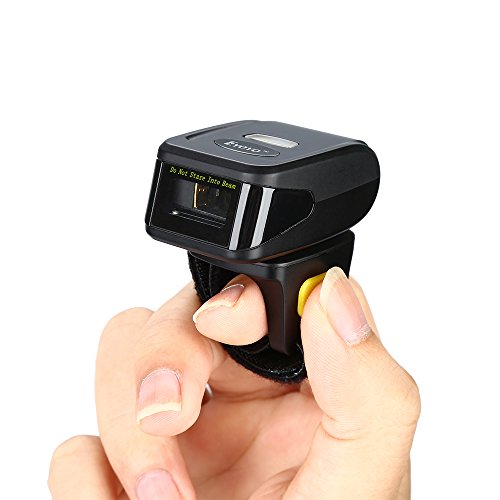
Eyoyo Wearable Ring Barcode Scanner Review Summary
The Eyoyo wearable ring barcode scanner makes sense for buyers who value hands-free scanning, multiple connection options, and broad compatibility over a general-purpose handheld form factor.
Its core appeal is workflow efficiency: you keep working while the scanner stays on your finger, and the listing supports both left- and right-hand use.
For retail stock checks, warehouse picking, library circulation, or registration desks, that design is more useful than a standard wand scanner if you scan frequently and move constantly.
If your work is built around printed 1D barcodes, this is a sensible specialist tool. If you need screen scanning or 2D QR support, it is the wrong category.
Review Scorecard
| Category | Score | Buyer assessment |
|---|---|---|
| Hands-free workflow | 9/10 | Ring design keeps both hands available for picking, packing, or handling items. |
| Connection flexibility | 9/10 | Bluetooth, 2.4G wireless, and USB wired modes cover most setups. |
| 1D scan usefulness | 8/10 | Supports common printed 1D codes and claims strong decoding on damaged or reflective labels. |
| Device compatibility | 8/10 | Listed for phones, tablets, PCs, POS systems, and major desktop OSs. |
| Battery practicality | 8/10 | Up to 8 hours of use and USB recharging suit a shift-based workflow. |
| Data handling | 8/10 | Storage mode and offline memory add insurance when range is limited. |
| Value for niche buyers | 8/10 | Strong feature set for mobile barcode work, but only if the workflow matches its limits. |
Key Features and Specifications of Eyoyo Wearable Ring Barcode Scanner
This Eyoyo scanner is a ring-style wearable unit with a reinforced 330° rotation head and an adjustable Velcro strap.
The listing says it is designed to fit comfortably on different finger sizes, including over gloves, which matters in warehouse and field environments.
It offers three connection modes: Bluetooth, 2.4G wireless, and USB wired.
The stated range is up to 30 m in 2.4G mode and up to 10 m in Bluetooth mode without barriers.
That gives it more flexibility than a fixed wired scanner, especially when the worker moves between shelves, bins, carts, or workstations.
The scanning focus is clear: printed 1D barcodes only.
The product details list UPC/EAN, Code 39, Interleaved 2 of 5, Code 93, Code 128, Codabar, Industrial 25, Matrix 25, and similar common formats.
The listing also says it can read damaged, distorted, colorful, and reflective 1D labels, but not barcode images from phone or computer screens, not 2D QR codes, and not silver metallic surfaces or foil paper.
Battery and storage are practical rather than flashy.
Eyoyo states up to 8 hours of continuous scanning, up to 720 hours of standby, and a 1.5-hour recharge via the included USB cable.
In storage mode, the built-in flash memory can hold up to 5,000 UPC barcodes offline, which is helpful when a live connection drops or you work beyond wireless range.
Other notable functions include custom prefix and suffix support, character deletion, keyboard-key insertion such as TAB or CR/LF, auto continuous scanning, and sound and vibration settings.
Those controls are useful if you need the scanner to match a specific software workflow.
Pros and Cons of Eyoyo Wearable Ring Barcode Scanner
Pros
- Hands-free design supports scanning while you keep working with both hands.
- Three connection modes make it easier to match laptops, tablets, phones, and POS setups.
- Broad 1D compatibility covers many common retail and inventory barcode types.
- Storage mode reduces the risk of data loss when you move outside range.
- Battery life and recharge speed are practical for shift work.
- Left- or right-hand wear improves comfort and rollout flexibility.
Cons
- No 2D QR support limits it to printed 1D workflows.
- No screen scanning means it is not for scanning codes from phones or monitors.
- Not for metallic or foil labels according to the listing.
- Specialized form factor may feel unnecessary if you only scan occasionally.
Who Should Buy Eyoyo Wearable Ring Barcode Scanner?
This is a good buy for workers who scan often and want their hands free.
That includes inventory staff, warehouse associates, logistics teams, event check-in crews, and library users who move from one item to the next all day.
The ring format is the main reason to choose it: it saves time in repetitive tasks where lifting a handheld scanner over and over becomes inefficient.
It also suits buyers who need multiple connection paths.
If you move between a tablet on one shift, a laptop the next, and a wired desk station later, the Bluetooth, 2.4G, and USB options reduce setup friction.
You should probably skip it if your workflow depends on QR codes, 2D symbols, or scanning from screens.
The listing is explicit that this is a printed 1D barcode scanner, so buyers who need broader code support should look elsewhere.
It is also not the best choice if you only scan a few items a day and do not benefit from the wearable design.
Scanning Workflow and Real-World Fit of Eyoyo Wearable Ring Barcode Scanner
Wearable Design Matters Most
The strongest feature here is not raw scanning power, but movement efficiency.
A ring scanner is built for repeated scans in active environments, so the worker can keep sorting, stocking, or packing while scanning.
That makes more sense than a tabletop or pistol grip scanner when the task is physically busy.
Connection Modes Change How You Can Deploy It
Bluetooth, 2.4G wireless, and USB wired support different jobs without forcing one setup on every team.
A warehouse cart, a mobile tablet station, and a fixed checkout area do not need the same connection type, and this product tries to cover all three.
That is a legitimate advantage if you manage mixed workflows.
1D Only Is a Feature and a Limit
For printed barcodes, the listing suggests strong decoding breadth.
But the same specificity becomes the biggest constraint.
If your operation has shifted toward QR-based ticketing, digital coupons, or mixed 1D/2D label sets, this model will feel narrow.
Buyers should treat that boundary as a purchase filter, not a small footnote.
Storage and Customization Help in Busy Operations
The built-in storage mode, prefix/suffix controls, and key insertion features are useful when the scanner has to fit software rules instead of just reading a code.
That is the kind of detail that matters in inventory systems, registration tools, and other structured workflows.
It is less exciting than the wearable design, but it is what makes the device operationally useful.
Alternatives to Eyoyo Wearable Ring Barcode Scanner
If you want a more traditional handheld option, look at NADAMOO barcode scanners.
They are a common Amazon search choice for buyers who want simple wireless scanning without the ring form factor.
If you need broader ecosystem recognition and fixed-station compatibility, Honeywell barcode scanners are a credible alternative line.
They are a safer comparison point for buyers who prioritize established enterprise hardware.
If you want a budget-friendly alternative with many consumer and SMB options, Tera barcode scanners are worth comparing.
They are often chosen by buyers who want general-purpose barcode reading rather than a specialized wearable device.
If you already know you need a wearable workflow but want to compare similar products, ring barcode scanners is the most relevant Amazon search.
That will surface adjacent models with similar hands-free use cases.
Is Eyoyo Wearable Ring Barcode Scanner Worth It?
Yes, if your work is built around printed 1D barcodes and you will benefit from a hands-free scanner. The Eyoyo wearable ring barcode scanner is most compelling for inventory, warehouse, logistics, and registration tasks where speed and mobility matter more than general-purpose scanning.
It is less compelling for mixed barcode environments, especially if you need QR support or screen scanning.
For the right buyer, though, the combination of wearable design, three connection modes, storage fallback, and shift-friendly battery life makes it a well-targeted tool rather than a gimmick.